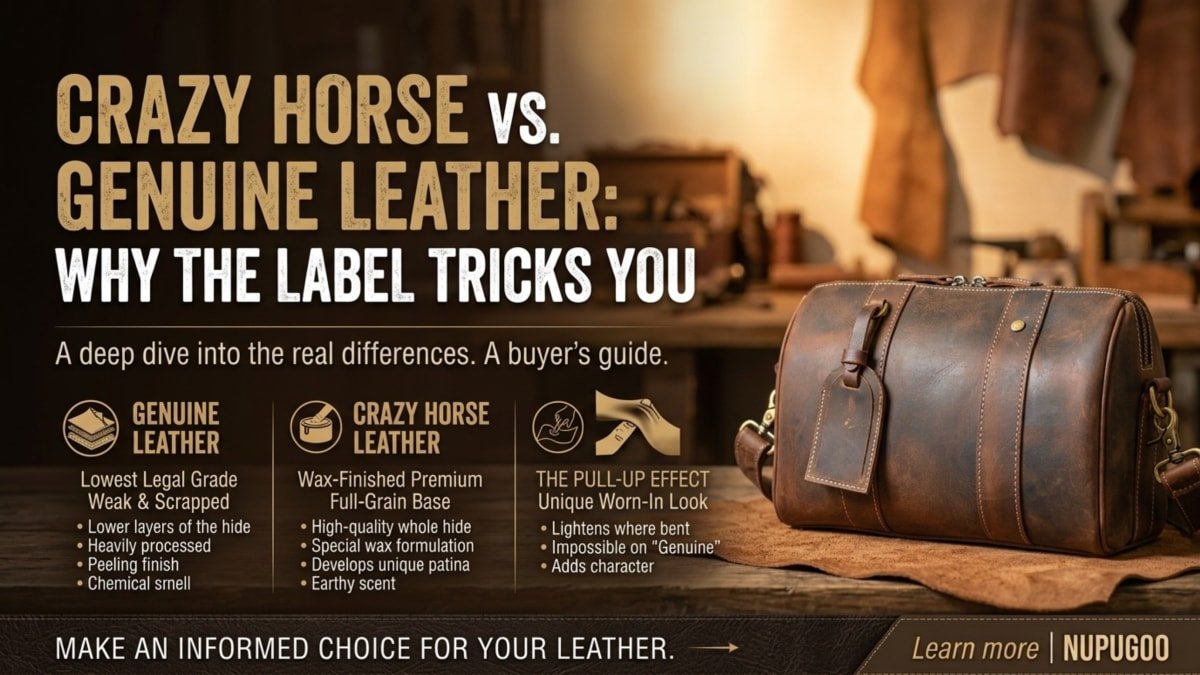
Crazy Horse Leather vs Genuine Leather: Why the Label Tricks You
Introduction
If you have ever shopped for a leather bag, wallet, or belt, you have seen the label: “Genuine Leather.”
It sounds premium. It sounds authentic. It sounds like the real deal.
Here is the uncomfortable truth the leather industry does not want you to know:
“Genuine Leather” is the lowest grade of real leather you can buy.
It is not a quality claim. It is a legal disclaimer — a way for manufacturers to call something “leather” without having to admit it is made from leather dust, scraps, and heavy glue.
In this guide, we are going to pull back the curtain. You will learn:
- What “Genuine Leather” actually means (and why it is a red flag)
- What Crazy Horse Leather is (and why it is in a completely different league)
- How to tell them apart in a store — without any tools
- Which one gives you better value for your money
- Why the label “Genuine Leather” should often make you less confident about a purchase, not more
By the end of this article, you will be able to walk into any leather shop and spot the difference in seconds.
Part 1: The “Genuine Leather” Trap
Why “Genuine” Sounds Better Than It Is
Marketing works by borrowing positive words and applying them to average products.
“Genuine” sounds like “authentic,” “real,” and “honest.” But in the leather industry, “Genuine Leather” is an official grade — and it is the lowest grade that still legally counts as “real leather.”
Here is the official leather grading hierarchy, from best to worst:
| Grade | What It Means | Durability | Price |
|---|---|---|---|
| Full-Grain | Top layer, unaltered, strongest fibers | ⭐⭐⭐⭐⭐ | $$$ |
| Top-Grain | Top layer, sanded smooth | ⭐⭐⭐⭐ | $$ |
| Genuine Leather | Lower layers, heavily processed, glued scraps | ⭐⭐ | $ |
| Bonded Leather | Leather dust + glue + vinyl backing | ⭐ | $ |
Key takeaway: “Genuine Leather” is not a synonym for “high quality.” It is a specific, low-tier category — one step above bonded leather (which is basically leather-flavored plastic).
How “Genuine Leather” Is Made
To understand why Genuine Leather performs poorly, you need to understand how it is made:
- The top layers of the hide are sliced off and sold as full-grain or top-grain leather (the profitable stuff).
- What is left is the corium — the fibrous, weak, loose lower layer of the hide.
- This leftover material is:
- Crushed into fibers,
- Mixed with polyurethane glue,
- Rolled into sheets,
- Coated with a plastic-like finish to make it look like real leather.
The result? A product that technically contains leather — but has almost none of leather is natural strength, breathability, or beauty.
It is the leather equivalent of MDF furniture (particle board dressed up to look like solid wood).
Part 2: What Is Crazy Horse Leather, Really?
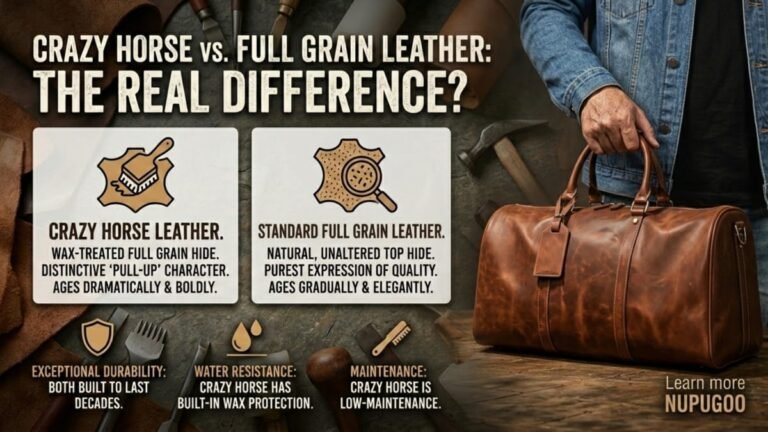
Crazy Horse Leather is not a grade. It is a finishing technique applied to full-grain or top-grain leather.
Here is how it is made:
- High-quality leather (usually full-grain) is selected as the base.
- A special wax formulation is worked into the surface.
- The wax fills the natural pores and creates a semi-gloss, slightly oily finish.
- The surface is intentionally left vulnerable to scratches — because those scratches are part of the design.
When you touch Crazy Horse Leather, you are feeling real, unbroken leather fibers — protected by wax, not hidden under plastic.
The Pull-Up Effect
The defining feature of Crazy Horse Leather is the Pull-Up Effect:
- When you bend or press the leather, the wax displaces.
- The leather lightens temporarily where it is stretched.
- When released, the wax settles back — often leaving a subtle color variation.
This effect is impossible to replicate in Genuine Leather, because Genuine Leather has a plastic coating that cracks before it stretches.
Part 3: Head-to-Head Comparison
| Feature | Crazy Horse Leather | Genuine Leather |
|---|---|---|
| Base Material | Full-grain or top-grain | Corium (lowest layer) or crushed scraps |
| Surface | Wax finish, natural grain visible | Plastic-like coating |
| Breathability | Breathable (wax is porous) | Non-breathable (sealed coating) |
| Durability | 10–20+ years | 1–3 years |
| Patina | Develops rich patina | Coating peels or cracks |
| Water Resistance | Good (wax repels water) | Poor (water sits on coating) |
| Scratch Repair | Easy (rub wax back in) | Impossible (coating cracks) |
| Smell | Natural leather scent | Chemical or plastic smell |
| Price Range | $50–$300 | $15–$80 |
| Ethical Note | Uses whole hides (less waste) | Uses scraps (but heavy glue) |
Part 4: 5-Second Store Test — How to Tell Them Apart
You are in a shop. You see two bags that look similar. One says “Crazy Horse Leather,” the other says “Genuine Leather.”
Here is how to know which is which — in under 5 seconds:
1. The Smell Test
- Crazy Horse: Smells like a saddle shop — earthy, rich, natural.
- Genuine Leather: Smells like chemicals, plastic, or has almost no smell at all.
2. The Scratch Test
- Take a key or fingernail. Gently press the surface.
- Crazy Horse: A mark appears — rub it with your finger and it fades or disappears (the wax moves back).
- Genuine Leather: Either nothing happens (coating too hard) or a permanent crack/peel appears (coating breaks).
3. The Bend Test
- Bend the leather sharply.
- Crazy Horse: Lightens where bent (Pull-Up Effect) — and returns to normal when released.
- Genuine Leather: The coating may crack or peel immediately. If it doesn’t crack, it just looks shiny and fake.
4. The Prick Test
- Look at the back side of a leather scrap or unfinished edge.
- Crazy Horse: Back side looks like suede — natural fiber.
- Genuine Leather: Back side looks like felt or cardboard — crushed fibers glued together.
5. The Price Test
- If a “leather” bag costs less than $30, it is almost certainly Genuine or Bonded Leather.
- Real full-grain Crazy Horse Leather cannot be produced that cheaply.
Part 5: Why Genuine Leather Still Exists (and Who Should Buy It)
If Genuine Leather is so bad, why does it still exist?
Two reasons:
- Price: It is cheap to produce. Brands can sell a “leather” bag for $25 that looks acceptable on a shelf.
- Appearance: The coating can be printed with any grain pattern, making low-quality leather look like expensive exotic skins.
Who Should Buy Genuine Leather?
Genuine Leather is not for everyone, but it does have a use case:
- You need a leather-looking item for a one-time event (photo shoot, costume, gift).
- You have a very tight budget and just want the look of leather, not the performance.
- You are buying for a child who will outgrow or destroy the item quickly.
If any of these describe you, Genuine Leather might be acceptable. But go in with realistic expectations.
Who Should Not Buy Genuine Leather?
- You want a bag that lasts more than 2 years.
- You care about how your belongings age and develop character.
- You are spending your own money and want value, not just a low price tag.
Part 6: Why Crazy Horse Leather Is Worth the Premium
A Crazy Horse Leather bag might cost 2–3× what a Genuine Leather bag costs. Here is why that premium is justified:
1. Cost Per Use
| Bag Type | Upfront Cost | Lifespan | Cost Per Year |
|---|---|---|---|
| Genuine Leather | $40 | 2 years | $20/year |
| Crazy Horse Leather | $120 | 10 years | $12/year |
The “cheap” bag is actually more expensive over time.
2. Aesthetics Over Time
- Genuine Leather: Starts okay, gets worse every month. Coating peels, edges fray, color fades unevenly.
- Crazy Horse Leather: Starts great, gets better every month. Patina deepens, character emerges, it becomes yours.
3. Repairability
- Genuine Leather: Once the coating cracks, the item is effectively trash. You cannot re-coat it at home.
- Crazy Horse Leather: Scratches? Rub them out. Dry? Condition it. Color faded? Re-wax it. It is user-serviceable for decades.
Part 7: Common Myths About “Genuine Leather”
Myth 1: “Genuine Leather means it is real leather.”
True but misleading. “Genuine Leather” is a grade, not a truth claim. Bonded leather is also “genuine leather” (it contains leather particles). The label tells you almost nothing about quality.
Myth 2: “If it says ‘genuine leather,’ it won’t peel.”
False. Genuine Leather routinely peels after 12–24 months because the thin coating cannot handle flex and heat.
Myth 3: “Crazy Horse Leather is just a marketing name.”
Partially true — but unimportant. “Crazy Horse” is a marketing name, but it describes a real, definable process (wax-finished full-grain leather). “Genuine Leather” is also a marketing name — but it describes a real, definable low grade.
Myth 4: “Genuine Leather is more ethical because it uses scraps.”
Misleading. While Genuine Leather does use hide scraps, it also uses significant polyurethane glue and chemical coatings. The environmental footprint is not clearly better.
Part 8: How to Care for Crazy Horse Leather
(Genuine Leather requires no “care” — once it peels, it is done. So this section is for Crazy Horse only.)
- Condition every 6–12 months with a beeswax-based leather conditioner.
- Buff out scratches with your fingertip (body heat + friction redistributes the wax).
- Store in a dust bag — not plastic. Leather needs to breathe.
- Avoid soaking — if it gets wet, stuff with newspaper and air-dry away from direct heat.
- Embrace the patina. The scratches and color changes are not damage — they are the leather living.
FAQ
Q: Can “Genuine Leather” be repaired?
A: Not practically. Once the coating peels or cracks, you cannot reapply it at home. A professional might be able to refinish it, but the cost usually exceeds the value of the item.
Q: Is Crazy Horse Leather full-grain or top-grain?
A: It can be either. High-end Crazy Horse Leather is full-grain. Mid-range is top-grain. Always ask the seller which one it is.
Q: Why does Genuine Leather smell bad?
A: The bonding glues and plastic coatings off-gas VOCs (volatile organic compounds). This chemical smell is a sign of low-quality materials.
Q: Can I make Genuine Leather last longer?
A: Not really. You can avoid getting it wet and keep it away from heat, but the coating will eventually fail. It is a consumable, not an investment.
Q: Is there a middle ground between Genuine and Crazy Horse?
A: Yes — Top-Grain Leather. It is sanded smooth, more uniform than full-grain, but still uses the top layer of the hide. More durable than Genuine, less character than Crazy Horse.
The Bottom Line
The leather industry uses confusing labels on purpose. “Genuine Leather” sounds like a quality claim, but it is actually a warning label.
If you want a bag that:
- Lasts 10+ years,
- Develops a unique patina that tells your story,
- Can be repaired at home,
- Gets better with age,
…then Crazy Horse Leather is the clear winner.
If you want a bag that:
- Costs under $40,
- Looks okay in photos,
- Will be replaced in 2 years anyway,
…then Genuine Leather might be “good enough.”
But now you know the difference. And once you know, you cannot un-know it.
Shop our collection of 100% full-grain Crazy Horse Leather bags at nupugoo.com — no “genuine leather” shortcuts, ever.