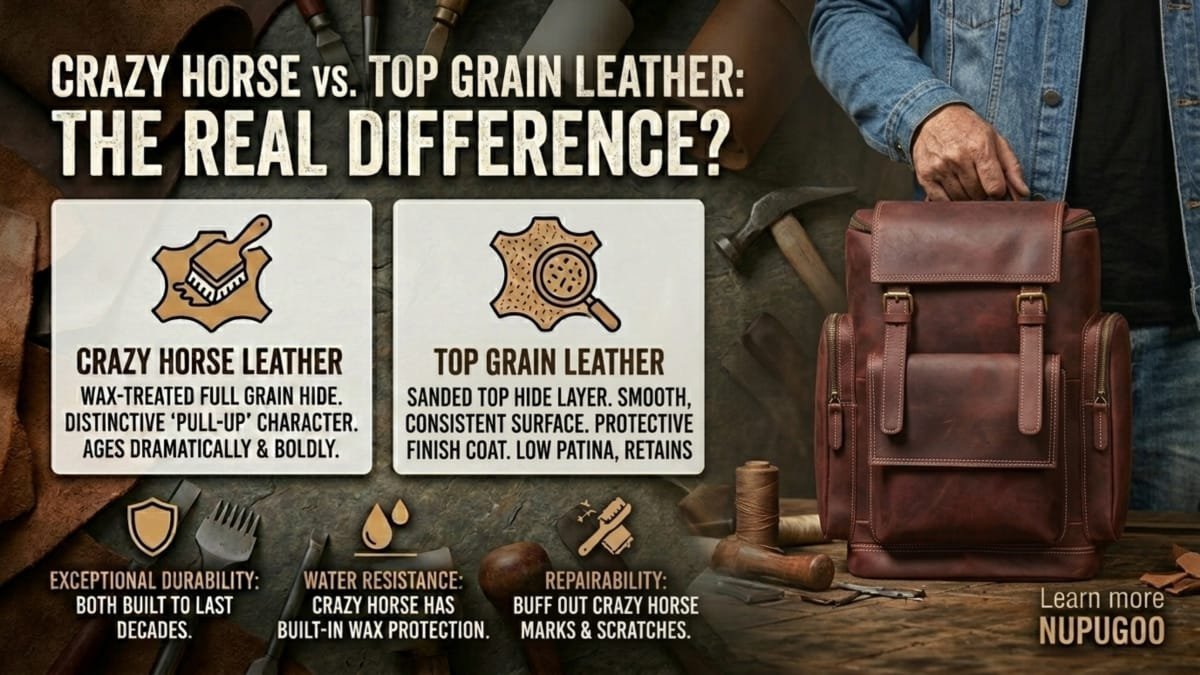
Crazy Horse Leather vs Top Grain Leather: What’s the Real Difference?
Introduction
If you have been shopping for a leather bag, wallet, or belt, you have probably come across terms like “Crazy Horse Leather” and “Top Grain Leather.” Both sound premium. Both look great in photos. But what do they actually mean — and which one is better for you?
Here’s the short answer: it depends on what you value most.
Crazy Horse Leather is all about character and patina — it tells your story over time. Top Grain Leather is about refinement and consistency — it looks polished from day one and stays that way with minimal effort.
This guide breaks down every meaningful difference so you can make a confident, informed purchase.
What Exactly Is Crazy Horse Leather?
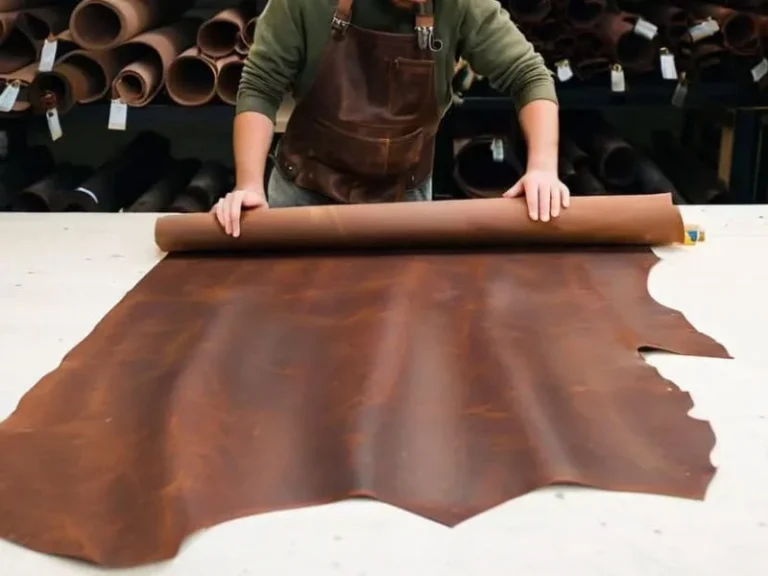
First, let’s clear up a common misconception. “Crazy Horse” isn’t a type of leather grade — it’s a finishing technique applied to full-grain leather.
Here’s how it’s made:
- Full-grain leather (the highest quality cut) is selected as the base.
- A special wax is applied across the surface.
- The wax penetrates the fibers, creating a unique look that changes with use.
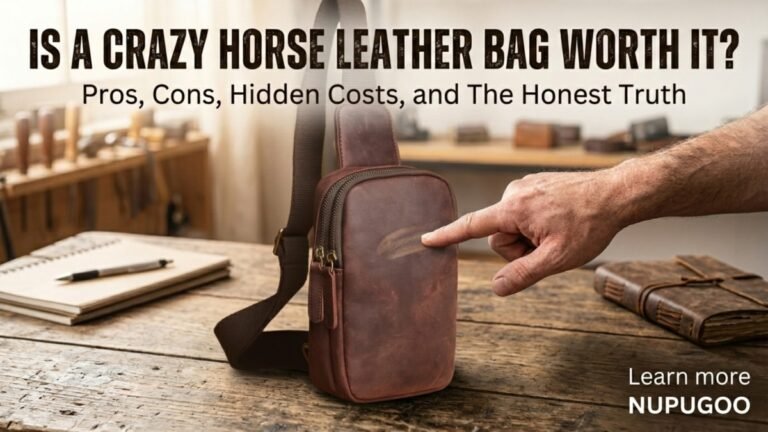
- Any scratches or marks can be easily rubbed away with a soft cloth, or left to blend into the patina.
The result? A leather surface that looks more rugged, more personal, and more alive than most alternatives.
Key characteristics:
- Made from full-grain leather (the starting material is top quality)
- Treated with special wax for a semi-gloss, antique finish
- Develops a rich patina over time
- Prone to scratches — but the wax makes them reversible
- Has a distinct, slightly oily texture
What Exactly Is Top Grain Leather?
Top Grain Leather is a grade of leather — specifically, it’s the second-highest quality tier after full-grain.
Here’s how it’s made:
- The top layer of a hide is split off (the outermost, densest part).
- The surface is sanded and buffed to remove imperfections.
- A coat or finish layer is applied — often with pigments or patterns.
- The result is a smooth, uniform surface that looks consistently refined.
Because the outermost layer (with the tightest fibers) is removed during sanding, top grain is slightly less durable than full-grain — but it’s more uniform and easier to work with.
Key characteristics:
- Made from the upper portion of the hide, sanded down
- Has a smooth, consistent surface with a finish coat
- More resistant to stains and scratches than Crazy Horse
- Doesn’t develop patina the same way
- Softer and more pliable than full-grain
- Usually embossed to mimic natural grain patterns
Head-to-Head Comparison
| Feature | Crazy Horse Leather | Top Grain Leather |
|---|---|---|
| Starting Material | Full-grain leather | Split or top portion of hide |
| Surface Treatment | Wax finish (no coating) | Sanded + finish coat |
| Texture and Feel | Textured, slightly oily | Smooth, uniform |
| Scratch Resistance | Low — wax makes marks reversible | Medium — protective coat helps |
| Patina Development | Yes, rich and dramatic over time | Minimal to none |
| Durability | Extremely high (full-grain base) | High, but slightly less than full-grain |
| Water Resistance | Better (wax repels water) | Poor without treatment |
| Color Consistency | Natural variation, unique each piece | Very consistent across pieces |
| Softness/Pliability | Firm initially, softens with use | Softer from the start |
| Repairability | Easy — rewax and buff | Moderate — color-matched dye needed |
| Price Range | $50–$300 | $30–$200 |
| Typical Products | Messenger bags, backpacks, belts | Handbags, wallets, shoes, watch straps |
The Pull-Up Effect: Crazy Horse Leather’s Secret Weapon
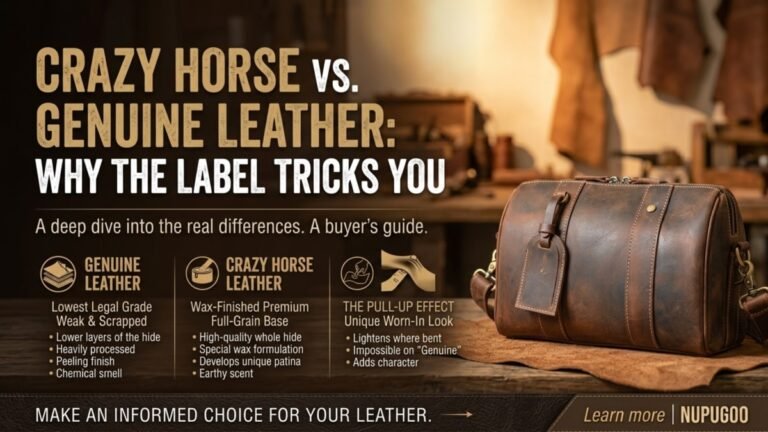
Here’s where Crazy Horse Leather truly shines: the Pull-Up Effect.
When you bend, stretch, or press on Crazy Horse Leather, the waxes in the leather temporarily displace and lighten — revealing a lighter shade underneath. When released, the color “pulls back” into place.
This effect:
- Gets more pronounced with age — your bag develops a richer, more personal look
- Tells your story — every crease, fold, and mark is a chapter in the life of the leather
- Can be reset — gently heat and buff to restore the original look (or embrace the new one)
Top Grain Leather doesn’t do this. Its finish coat prevents the natural fiber movement that creates the Pull-Up Effect. What you see on day one is largely what you’ll see years later — just a little more worn.
Durability: Which Lasts Longer?
Crazy Horse Leather wins on raw durability.
Because it starts with full-grain leather — the densest, strongest part of the hide — and adds a protective wax layer, Crazy Horse Leather is among the most durable leathers available.
- The wax layer provides water and abrasion resistance
- Full-grain fibers are incredibly dense and tear-resistant
- With proper care, Crazy Horse Leather can last decades
Top Grain Leather is still durable, but the sanding process removes some of the strongest outer fibers, and the finish coat can crack or peel over time (10–15 years).
Aging: How Each Leather Changes Over Time
Crazy Horse Leather
- New: Rich color, wax sheen, slight texture variation
- 3–6 months: First patina hints — areas of use begin to lighten or deepen
- 1–3 years: Distinctive patina developing — unique to your use patterns
- 5+ years: Deep, rich patina — looks better than new in many cases
- 10+ years: Vintage character; the leather has become a personal artifact
Top Grain Leather
- New: Smooth, consistent, polished appearance
- 1–2 years: Finish coat begins showing wear; minor scratches appear
- 3–5 years: Finish may crack or peel in high-flex areas
- 5–10 years: Visible aging; may need reconditioning or repainting
- 10+ years: Finish deterioration visible; leather beneath may be exposed
Water and Weather Resistance
This is one area where Crazy Horse Leather has a clear advantage.
The wax coating naturally repels water — light rain, spills, and moisture bead up on the surface rather than soaking in. For leather that’s going to be used outdoors, on commutes, or in variable climates, this is a significant benefit.
Quick tip: For both leathers, if they get soaking wet, let them air dry slowly — never near direct heat. Stuff with newspaper to help retain shape.
Scratch Resistance and Repair
This is where Top Grain Leather pulls ahead.
The sanded surface and finish coat on Top Grain Leather provide a protective layer that resists minor scratches. Daily use — coins in a pocket, keys in a bag — is less likely to leave visible marks.
Crazy Horse Leather is more prone to visible scratches — but most scratches can be easily repaired:
- Minor scratches: Rub gently with a soft cloth or your fingertip. The wax will warm up and the mark will fade or disappear.
- Deeper scratches: Apply a small amount of leather balm or beeswax, rub in with a cloth, and buff.
- Stubborn marks: A hairdryer on low heat applied to the area will soften the wax and help it redistribute.
For Top Grain Leather scratches: you’ll need color-matched leather dye or polish, and repairs are more noticeable.
Price Comparison
Crazy Horse Leather
- Base cost is higher because it starts with full-grain leather
- Price range: roughly $50–$300 depending on the product and manufacturer
- You pay more upfront, but get a product that ages spectacularly
- At nupugoo.com, our Crazy Horse Leather bags typically range from $65–$180
Top Grain Leather
- Less expensive because the sanding and finishing process is faster and uses lower-grade hides
- Price range: roughly $30–$200 depending on the brand
- More affordable entry point, but may need replacement sooner
- Common in mid-range handbags, wallets, and accessories from major brands
The long view: If you buy a $150 Crazy Horse Leather bag that looks better after 5 years, it’s arguably better value than a $100 Top Grain bag that needs replacing after 8 years.
Which Should You Choose?
Choose Crazy Horse Leather if you:
- Value unique, personal character over uniformity
- Want a product that gets better with age
- Appreciate the Pull-Up Effect and leather that tells a story
- Need something durable and weather-resistant
- Enjoy the idea of a heirloom-quality item
- Don’t mind putting in a little basic care (conditioning once a year)
- Want repairability without professional help
Choose Top Grain Leather if you:
- Prefer a smooth, polished, consistent look
- Want low-maintenance — looks good with minimal care
- Need something softer and more pliable from day one
- Want more scratch resistance for daily use
- Prefer products that look the same year after year
- Have a tighter budget but still want quality
- Want a wider range of colors and finishes to choose from
Common Misconceptions
“Crazy Horse Leather is a grade, like ‘top grain’ or ‘full grain.'”
False. Crazy Horse is a finishing technique, not a grade. In terms of the starting material, it’s actually better than Top Grain.
“Top Grain Leather is just cheap leather.”
Not fair. Top Grain is the second-highest leather grade available. It sacrifices a bit of durability for a smoother, more uniform appearance.
“Crazy Horse Leather scratches easily, so it’s not durable.”
False. It scratches more easily in the sense that marks are visible — but the wax makes them reversible. Many owners actually prefer the scratches as part of the patina.
“Top Grain Leather doesn’t age well.”
Partially true. Top Grain doesn’t develop a patina — the finish coat prevents that. But it can still age well if the finish holds up.
How to Care for Each
Caring for Crazy Horse Leather
- Condition once or twice a year with leather balm or beeswax-based conditioner
- Buff out scratches with your fingertips or a soft cloth
- Avoid prolonged soaking — if wet, air dry slowly away from direct heat
- Store in a breathable dust bag — not plastic (leather needs to breathe)
- Embrace the patina — the aging process is a feature, not a bug
Caring for Top Grain Leather
- Wipe clean regularly with a soft, dry cloth
- Condition every 6–12 months with a cream-based leather conditioner
- Avoid over-exposing to direct sunlight — can cause fading
- Touch up scratches with color-matched leather dye or polish
- Re-apply finish if cracking occurs (can be done with leather refinishing products)
FAQ
Q: Can Crazy Horse Leather be used for shoes?
A: Absolutely — it’s one of the most common leathers for premium boots and shoes. The wax finish provides excellent durability and water resistance for footwear.
Q: Is Top Grain Leather the same as “genuine leather”?
A: No. “Genuine leather” is actually a lower grade — it’s the third tier down from full-grain. Top Grain is higher quality than genuine leather.
Q: Does Crazy Horse Leather smell different from Top Grain?
A: Both should smell like leather — earthy, natural, and animal-based. Chemical or plastic smells indicate poor quality.
Q: Which is better for a daily commute bag?
A: Crazy Horse Leather — the wax finish provides better water resistance and the durability of full-grain leather makes it ideal for daily use.
Q: Can I waterproof Crazy Horse Leather?
A: The wax already provides some water resistance. For extra protection, you can apply a leather waterproofing spray — but test it on a small area first.
The Bottom Line
Both Crazy Horse Leather and Top Grain Leather are quality materials — the comparison isn’t about “good vs. bad,” it’s about two different philosophies:
- Crazy Horse Leather is for people who want to build something — a patina, a story, a personal artifact that gets better with every use.
- Top Grain Leather is for people who want immediate polish — a refined, consistent look with minimal maintenance.
Neither choice is wrong. At nupugoo.com, we work with both materials because they serve different needs and different people.
The right question isn’t “which leather is better?” — it’s “which leather is better for me?”
Ready to find your perfect leather? Browse our collection of Crazy Horse Leather bags and accessories at nupugoo.com.