Cheap vs Expensive Leather Bags: What the Price Tag Actually Tells You
Introduction
You have probably seen them side by side in a store: a $30 leather bag and a $300 leather bag. They look almost identical in photos. They both say “leather” on the tag. They might even feel similar when you touch them briefly.
So what exactly are you paying three times more for?
The short answer: everything that matters.
The longer answer is what this article is about — a clear, honest, side-by-side comparison that will help you understand exactly where your money goes when you buy a quality leather bag, and why the “bargain” option almost always costs you more in the long run.
The Price Spectrum: What $30 vs $300 Actually Means
Before we compare, let us establish what “cheap” and “expensive” mean in the leather bag market:
| Category | Price Range | Typical Leather Type | Typical Origin |
|---|---|---|---|
| Budget | $15 – $50 | Genuine Leather / Bonded Leather / PU | China, India, Pakistan |
| Mid-Range | $50 – $150 | Top-Grain / Quality Crazy Horse | China, Turkey, Italy |
| Premium | $150 – $500 | Full-Grain (often Italian or European) | Italy, France, Spain |
| Luxury | $500+ | Exotic leathers / Full-Grain + artisan work | Italy, France / Artisan workshops |
For this article, we are primarily comparing the $30 budget category against the $150–$300 premium category — because this is the range where most buyers make their real decision.
What Goes Into a $30 Leather Bag?
The Leather
At $30, you are almost certainly getting one of these:
- Genuine Leather — the lowest real leather grade, made from the scraps and loose fibers of the hide, bonded with polyurethane glue and finished with a plastic coating.
- Bonded Leather — leather dust and waste, compressed into sheets with massive amounts of glue, with a vinyl or polyurethane surface layer.
- PU Leather (Polyurethane) — completely synthetic. Zero animal hide. It is 100% plastic with a printed grain texture.
None of these are inherently evil. But all of them share one problem: they look acceptable on day one and deteriorate from there.
The Hardware
Budget bags use zinc alloy or low-grade brass hardware:
- Clasps and zippers rust within 6–18 months
- Metal surfaces flake and tarnish
- Magnetic closures lose strength quickly
- Strap attachments use thin, weak stitching
A rusted clasp on an otherwise intact bag is one of the most common reasons people throw away otherwise salvageable bags.
The Construction
- Thin leather — often 0.3–0.5mm thick instead of the standard 1.0–1.5mm
- Glued seams instead of stitched — glue fails, stitches do not
- Minimal stitching — often 4–6 stitches per centimeter instead of the standard 8–10
- No edge finishing — raw edges are simply painted over, which chips within months
The Labor
At $30 retail, the factory worker making the bag earns a fraction of a living wage. This is not just an ethical concern — it directly affects quality. Unmotivated, rushed labor makes mistakes. Mistakes mean weak seams, misaligned edges, and premature failure.
What Goes Into a $150–$300 Leather Bag?
The Leather
At this price, you are getting full-grain or high-quality top-grain leather:
- Full-Grain Leather — the entire top layer of the hide, with all natural grain and fibers intact. The strongest, most durable leather available.
- Crazy Horse Leather — full-grain leather with a wax finish. Combines maximum durability with a beautiful patina that improves over time.
- Top-Grain Leather — the top layer, sanded smooth. Slightly less rugged than full-grain, but very consistent in appearance and still highly durable.
This leather is typically 1.0–2.0mm thick, sourced from better tanneries, and tanned using better processes that extend its lifespan dramatically.
The Hardware
Quality bags use solid brass, stainless steel, or high-grade zamak:
- Hardware is weighty and solid — you can feel the difference immediately
- Antiqued or lacquered finishes that do not flake
- YKK or RiRi zippers — the industry standard for quality
- Solid rivet construction for strap attachments
The Construction
- Hand-stitched or precision machine-stitched — typically 8–10 stitches per centimeter with waxed thread
- Folded and burnished edges — edges are folded, sealed, and polished so they look clean and last
- Interior lining — usually cotton, canvas, or microsuede — that protects the leather structure
- Reinforced stress points — handles, strap attachments, and corners are double-stitched or riveted
The Labor
Better-paid workers produce better work. At this price level, bags are often made in facilities with better quality control, lower production volumes, and workers who take pride in their craft.
Side-by-Side: The 12 Differences That Matter
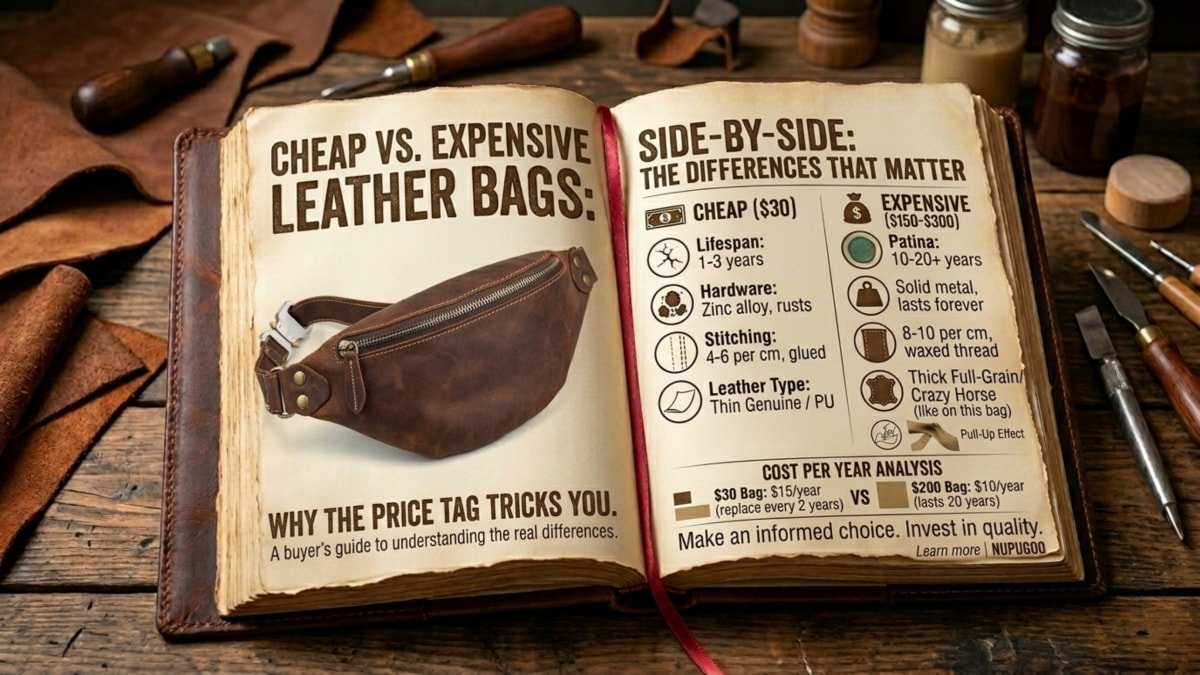
| Feature | $30 Bag | $150–$300 Bag |
|---|---|---|
| Leather Thickness | 0.3–0.5mm | 1.0–2.0mm |
| Leather Type | Genuine / Bonded / PU | Full-Grain / Top-Grain |
| Lifespan | 1–3 years | 10–20+ years |
| Hardware | Zinc alloy, flakes and rusts | Solid brass/stainless, lasts forever |
| Stitching | 4–6 per cm, glued seams | 8–10 per cm, waxed thread |
| Edge Finish | Painted over, chips | Burnished and sealed |
| Interior Lining | Thin plastic or none | Cotton/canvas/microsuede |
| Strap Attachments | Thin stitching only | Double-stitched + rivets |
| Smell | Chemical/plastic | Natural leather |
| Aging | Coating peels, cracks, fades | Rich patina develops |
| Repairability | Essentially disposable | Fully repairable |
| Resale Value | $0 | $50–$150 (vintage market) |
The Real Cost: Cost Per Year Analysis
Here is where the math gets uncomfortable for budget bags:
| Bag Type | Purchase Price | Replacement Frequency | 10-Year Cost | Cost Per Year |
|---|---|---|---|---|
| $30 bag | $30 | Every 2 years | $150 (5 bags) | $15/year |
| $200 bag | $200 | Every 10 years | $200 (1 bag) | $20/year |
| $200 bag (20yr life) | $200 | Every 20 years | $200 (1 bag) | $10/year |
The surprise: A quality bag that lasts 10 years costs roughly the same per year as a budget bag — and if it lasts 20 years, it actually costs less per year.
But the comparison misses one crucial variable: time.
- Every time you replace a budget bag, you spend time shopping for it, receiving it, checking it, and eventually discarding it.
- A quality bag buys you freedom from that cycle for a decade or more.
What $300 Extra Dollars Can Buy Instead
Critics of premium leather bags often ask: “Is it really worth $270 more?”
Let us flip the question: what else could that $270 buy?
- A quality leather bag: $270 worth of experiences, skills, or savings
- 5 × $30 bags over 10 years: $150 + dozens of hours of shopping/replacing
The real comparison is not “one $30 bag vs one $300 bag.” It is:
“A 20-year companion vs. a revolving door of frustration.”
Red Flags: How to Spot a Bad Leather Bag Before You Buy
Whether online or in-store, watch for these warning signs:
1. Price That Is Too Low
A leather bag priced under $25 is almost never made with real, quality leather. If it says “Genuine Leather” and costs $20 — it is Genuine Leather, which is the lowest grade.
2. Vague Descriptions
“Premium Leather” without specifying the grade is a red flag. Responsible brands say: “Full-Grain Cowhide” or “Crazy Horse Leather (Full-Grain Base)”. Vague marketing language hides low-quality materials.
3. Perfect, Uniform Surface
Real leather — especially full-grain — has natural variations, small scars, and grain inconsistencies. If every section of the bag looks identical, it is either top-grain with heavy coating or fake leather with a printed surface.
4. Plastic Smell
Smell the bag (or the product page reviews). A chemical, plastic, or “new car” smell indicates polyurethane coatings and low-quality adhesives.
5. No Information About Hardware
Quality brands specify their zippers (YKK, RiRi) and hardware materials. Budget brands skip this information because their hardware is unremarkable.
6. High Return Rates or Negative Reviews About Peeling
Check reviews carefully. “Peeling,” “cracking,” “smell won’t go away,” and “looks cheap after one month” are the most common complaints about budget leather bags.
The One Case Where Budget Leather Makes Sense
There is exactly one scenario where a budget leather bag is a reasonable choice:
You need something for a specific, short-term occasion — and you know it will be replaced.
Examples:
- A costume or photo shoot prop
- A travel bag you plan to check and potentially damage
- A child’s first “fancy” bag that will inevitably be dropped, stained, or outgrown
- A gift for someone whose preferences you are still learning
In these cases, a $30 bag serves its purpose perfectly. Just do not expect it to age gracefully or last beyond its occasion.
For every other use case — your everyday bag, your work bag, your travel companion, the bag you use every single day — the premium option is the rational choice.
How to Buy Smart: Getting the Best Value in Leather Bags
You do not always need to spend $300 to get quality. Here is how to find the sweet spot:
1. Learn the Leather Grades
Full-Grain > Top-Grain > Genuine Leather > Bonded Leather > PU Leather
As long as you are buying Full-Grain or Top-Grain, you are in the quality zone — regardless of the brand name.
2. Check the Hardware
YKK zippers, solid brass clasps, and riveted construction are non-negotiable markers of quality. If a bag has these, the leather almost certainly matches.
3. Feel the Weight
Quality leather is substantial. A flimsy, lightweight bag almost always means thin, low-grade leather. Pick it up — a real leather bag should feel like it has substance.
4. Inspect the Stitching
Count the stitches per centimeter. Eight to ten means quality. Four to six means the bag will fall apart at the seams. Look at the stitching on handles and strap attachments specifically — this is where cheap bags fail first.
5. Buy From Brands That Explain Their Leather
The best sign of a quality brand: they tell you exactly what leather they use and where it comes from. If a brand’s product page says “premium leather” without specifying, keep looking.
The Psychology of the Budget Bag Trap
Why do people keep buying $30 leather bags even though they know they will not last?
It is not stupidity. It is psychology:
- The Sunk Cost Illusion: “I only spent $30, so it is fine if it breaks.” But five $30 bags cost more than one good one.
- Instant Gratification: A new bag feels exciting. The pain of replacing it 18 months later feels distant and abstract.
- Optimism Bias: “This one will be different.” It will not.
- Status Misalignment: Buying a $300 bag “feels” indulgent, even when it is actually the financially smarter choice.
Recognizing these biases is the first step to making a genuinely rational purchase decision.
FAQ
Q: Can a $50 bag be good quality?
A: Occasionally, yes — especially if it is on sale or from a direct-to-consumer brand. But at $50, you are on the edge of quality territory. Scrutinize the leather grade and stitching before buying.
Q: Is Italian leather always better?
A: Not automatically. Italian leather refers to leather tanned in Italy — which is often excellent — but it can still be Genuine Leather or Top-Grain. Always check the specific grade, not just the country of origin.
Q: How can I tell if a bag is real full-grain leather?
A: (1) Look for natural surface variations and small imperfections. (2) The back should look like suede. (3) It should smell like natural leather. (4) It should be heavy and substantial. (5) The Pull-Up Test: bend it and the color should lighten temporarily.
Q: Is Crazy Horse Leather worth the premium over regular full-grain?
A: Crazy Horse Leather is a type of full-grain leather with a wax finish. It offers the same durability as regular full-grain, plus the added benefit of the Pull-Up Effect and superior scratch resistance. For everyday bags, it is often the best value in the premium category.
Q: What should I do if I already own several budget leather bags?
A: Use them up — there is no point in discarding functional items prematurely. But when it is time to replace them, upgrade intentionally. One quality bag will outlast all of them combined.
Q: Do expensive bags from luxury brands justify their price?
A: Not always. A $1,000 bag from a luxury brand often uses the same leather as a $200 bag from a quality independent brand. You are paying for the logo and the brand story, not necessarily the materials or construction. Buy quality, not logos.
The Bottom Line
The $30 leather bag and the $300 leather bag look similar on a website. In real life, they are completely different products with completely different purposes.
The $30 bag is a disposable accessory — acceptable for a specific occasion, not for daily life.
The $300 bag is a long-term investment — one that costs about the same per year as its cheap counterpart, but delivers decades of use, character, and reliability instead of a repeating cycle of disappointment.
You do not need to buy the most expensive bag. You just need to buy the right grade of leather (Full-Grain or Top-Grain), quality hardware, and decent construction. That combination typically costs $100–$300 — and it is worth every cent.
Your next bag does not have to be a luxury brand. It just has to be made right.
Explore our collection of 100% Full-Grain Crazy Horse Leather bags at nupugoo.com — built to last, not built to be replaced.