Crazy Horse Leather vs Oil Wax Leather: A Practical Comparison
Introduction
If you have been shopping for wax-finished leather goods, you have almost certainly encountered two names that sound similar but are not quite the same: Crazy Horse Leather and Oil Wax Leather.
Both are premium leather types with wax finishes. Both develop beautiful patinas. Both are more durable and repairable than most leather alternatives on the market.
But they are not identical. And if you are choosing between them for a specific product — a bag, a belt, a wallet, a strap — the differences matter.
In this guide, we break down exactly what each leather is, how they are made, how they age, and which one is better suited for different use cases.
Part 1: What Is Crazy Horse Leather?
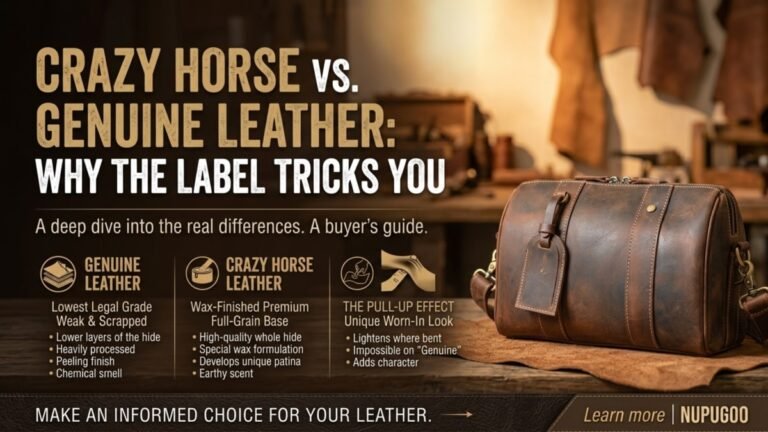
As covered in our previous guides, Crazy Horse Leather is a finishing technique applied to full-grain leather, using a blend of waxes — primarily beeswax, along with oils and tallow — worked into the surface of the hide.
The result is a leather that is:
- Durable — it uses full-grain as its base, the strongest cut of the hide
- Protective — the wax layer provides water resistance and scratch resistance
- Alive — it develops a rich patina over time that makes each piece unique
- Repairable — most scratches can be rubbed out with body heat and a soft cloth
The term “Crazy Horse” is a brand name from the original Dutch manufacturer, but it has become a generic industry term for wax-finished full-grain leather. It is also sometimes called “Crazy Horse Leather” or simply “waxed leather.”
Key Characteristics of Crazy Horse Leather
- Wax blend: Primarily beeswax-based, often with tallow and natural oils
- Finish appearance: Semi-gloss, slightly oily sheen; natural grain fully visible
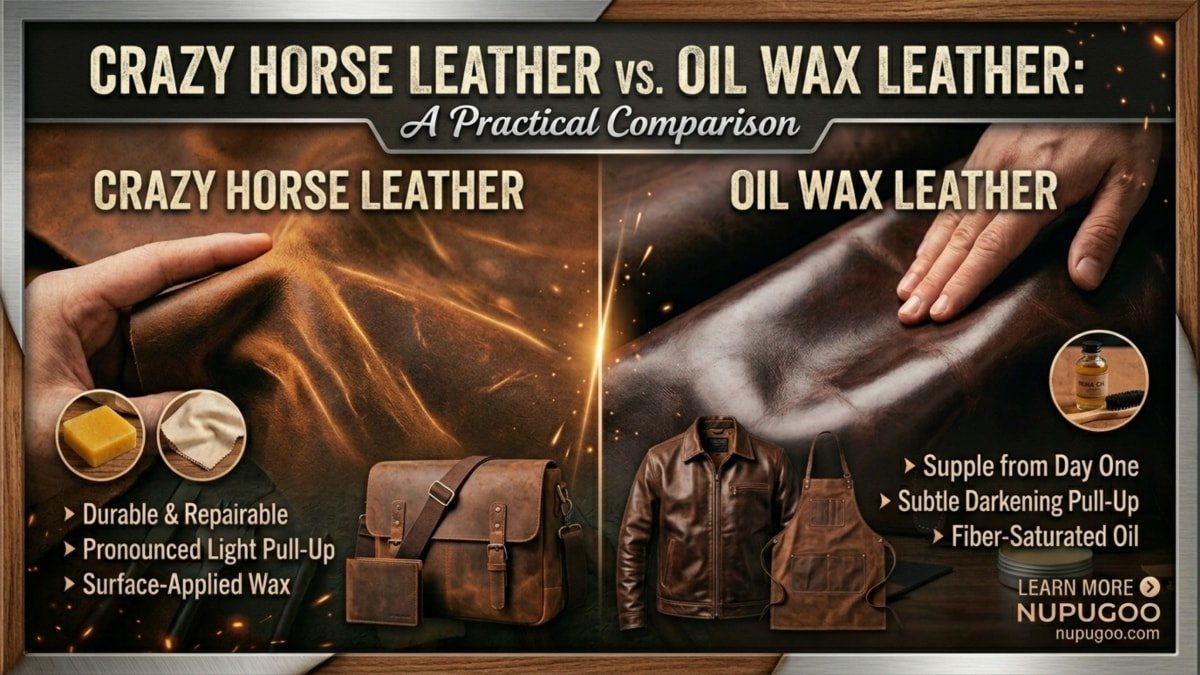
- Pull-Up Effect: Pronounced — color lightens dramatically when bent or stretched
- Scratch behavior: Marks appear easily but fade when rubbed
- Available colors: Cognac, brown, black, olive (most common); natural and tan (less common)
- Typical uses: Messenger bags, backpacks, belts, watch straps, equestrian goods
Part 2: What Is Oil Wax Leather?
Oil Wax Leather is also a wax-finished leather, but it uses a different wax-and-oil formulation applied differently during the tanning process.
The key distinction is in the ratio and application method:
- In Crazy Horse Leather, wax is applied to the surface of finished full-grain leather and buffed in.
- In Oil Wax Leather, a heavier oil-wax blend is often worked into the leather during the tanning stage, saturating the fibers from within rather than coating the surface.
This difference in application gives Oil Wax Leather a distinctly different feel and performance profile.
Key Characteristics of Oil Wax Leather
- Wax blend: Heavy on oils (mink oil, cod oil, or lanolin) with wax; the oil content is higher than Crazy Horse
- Finish appearance: Rich, glossy, almost wet-looking; the grain is visible but has a deeper saturation
- Pull-Up Effect: Present, but subtler than Crazy Horse — the darkening effect is more pronounced than the lightening
- Scratch behavior: Scratches are less visible to begin with due to the oil saturation; natural oils help marks blend in
- Available colors: Dark brown, tan, burgundy, black (most common); more limited than Crazy Horse
- Typical uses: Jackets, aprons, tool rolls, work bags, outdoor gear, motorcycle gear
Part 3: Head-to-Head Comparison
| Feature | Crazy Horse Leather | Oil Wax Leather |
|---|---|---|
| Base Material | Full-grain leather (almost always) | Full-grain or top-grain leather |
| Wax/Oil Formula | Beeswax-dominant, surface-applied | Oil-dominant (mink/cod/lanolin), fiber-saturated |
| Surface Feel | Dry, slightly waxy, firm | Rich, slightly greasy, supple |
| Sheen | Semi-gloss, natural | High gloss, almost wet-looking |
| Pull-Up Effect | Strong — color lightens visibly | Moderate — darkening is more visible |
| Scratch Visibility | Moderate — marks appear but fade | Low — oil saturation hides marks |
| Water Resistance | Good (wax repels water) | Very Good (oil saturates fibers, resists moisture) |
| Durability | 10–20+ years | 10–20+ years |
| Flexibility | Firm initially, softens with use | Supple from the start, very pliable |
| Oil Migration | Minimal | Moderate — may transfer to light fabrics |
| Color Options | Wider range | More limited, focused on rich tones |
| Repair Difficulty | Easy — rub out scratches | Moderate — re-oil and condition |
| Typical Price | $60–$180 | $50–$160 |
| Common Uses | Bags, belts, watch straps | Jackets, aprons, tool rolls, work gear |
Part 4: The Pull-Up Effect — A Key Difference
The Pull-Up Effect is one of the most celebrated characteristics of both leathers, but they express it differently.
Crazy Horse Leather Pull-Up
When you bend Crazy Horse Leather:
- The wax coating displaces and separates from the fibers.
- The fibers lighten in color where they are stretched.
- The effect is pronounced and visible from a distance.
- When released, the wax slowly redistributes, and the color returns (unless you choose to embrace the new shade).
This is the signature “Crazy Horse look” — the dramatic, theatrical color shift that makes every bag look different over time.
Oil Wax Leather Pull-Up
Oil Wax Leather has a subtler version of the Pull-Up Effect:
- The oil-wax blend inside the fibers shifts under pressure.
- The result is more of a deepening or darkening rather than a lightening.
- The effect is more subtle and refined — visible up close but not dramatic from a distance.
This gives Oil Wax Leather a more consistent, refined appearance over time — the changes are there, but understated.
Which Pull-Up is better? Neither — it depends on what you prefer. Crazy Horse is for those who love dramatic patina changes and visible character. Oil Wax is for those who prefer subtle, refined aging.
Part 5: Scratch Resistance and Repair
Crazy Horse Leather
Crazy Horse Leather scratches relatively easily — but the good news is that most scratches are easily reversible:
- Minor scratches: Rub gently with your fingertip (body heat warms the wax and it redistributes)
- Deeper scratches: Apply a small amount of leather balm or beeswax, buff with a soft cloth
- Stubborn marks: A hairdryer on low heat applied briefly will soften the wax layer
The trade-off is that scratches are visible before you fix them — which some people love (it shows the leather is being used) and others find bothersome.
Oil Wax Leather
Oil Wax Leather is more forgiving with scratches:
- The oil saturation naturally blends minor surface marks over time
- Scratches are less visible even without active repair
- For deeper marks: apply a light coat of mink oil or leather conditioner, buff in
- The leather absorbs conditioner readily due to its open fiber structure
Oil Wax Leather is better suited for people who want a low-maintenance patina — the aging happens naturally with less intervention required.
Part 6: Water Resistance and Outdoor Use
Both leathers handle water better than unfinished leather, but there is a meaningful difference:
Crazy Horse Leather
The wax coating on Crazy Horse Leather repels water on contact:
- Light rain beads up and runs off the surface
- The wax coating prevents water from soaking in quickly
- If soaked, the leather will darken temporarily but recover as it dries
- Prolonged soaking can cause the wax to migrate — condition after getting thoroughly wet
Oil Wax Leather
Oil Wax Leather is more naturally water-resistant due to the oil saturation:
- Oils naturally repel water at a fiber level — deeper protection than surface wax
- Handles rain and splashes very well
- The leather softens slightly when wet but regains its shape when dried
- Excellent for outdoor gear, work bags, and motorcycle gear
Winner for outdoor/water exposure: Oil Wax Leather — the oil saturation provides deeper, more durable water resistance.
Part 7: The Oil Migration Issue
Here is one disadvantage of Oil Wax Leather that Crazy Horse does not have: oil migration.
Because Oil Wax Leather contains a high proportion of liquid oils (mink oil, cod oil, etc.), these oils can gradually transfer to adjacent materials over time:
- Light-colored fabrics: Jeans, light-colored shirts, or bags stored next to light fabrics may pick up slight discoloration over months of contact
- Paper and cardboard: Oil Wax Leather should not be stored in cardboard boxes — the oils will stain the cardboard and the cardboard may affect the leather
- Initial transfer: When new, Oil Wax Leather may leave a slight oily mark on hands or clothing — this decreases as the leather is used and the surface oils are absorbed
Crazy Horse Leather has no oil migration issue — the beeswax coating stays on the surface and does not transfer to other materials.
Practical tip: If you wear light-colored clothing and carry your bag against your clothes, Crazy Horse Leather is the safer choice.
Part 8: Which One Should You Choose?
Here is a quick decision framework:
Choose Crazy Horse Leather if you want:
- A bag or accessory (messenger bag, backpack, belt, wallet, watch strap)
- Dramatic patina changes over time
- Scratches that you can see and feel the process of healing
- A leather that is firm and structured with a natural, matte-to-semi-gloss finish
- No risk of oil transfer to your clothes or other materials
- The option to reset or enhance the finish with beeswax
- A leather that is more widely available and easier to find in a range of colors and products
Choose Oil Wax Leather if you want:
- A jacket, apron, tool roll, or work gear
- Subtle, refined aging — you prefer understated over dramatic
- A leather that is supple and pliable from day one
- Better scratch resistance with less visible marks
- Deeper water resistance for outdoor or work use
- Low-maintenance aging — let it do its thing naturally
- A more classic, rich, slightly vintage aesthetic
For Bags Specifically
For everyday bags, messenger bags, backpacks, and briefcases, both are excellent choices — and both are far superior to standard leather.
If you are choosing between the two for a bag:
- Crazy Horse tends to be the more popular choice for bags — the dramatic patina and firm structure work beautifully for bag applications, and the wax coating is practical for daily commute use.
- Oil Wax is an excellent alternative for bags that will see heavy outdoor use or need to be particularly supple.
Part 9: How to Care for Each
Caring for Crazy Horse Leather
- Condition 1–2 times per year with a beeswax-based leather balm (not heavy oils — they can soften the leather too much)
- Buff out scratches with your fingertips or a soft cloth
- Air dry if wet — stuff with newspaper, dry away from direct heat
- Store in a breathable dust bag — never in plastic
- Embrace the patina — the more you use it, the better it looks
Caring for Oil Wax Leather
- Condition 1–2 times per year with mink oil, leather conditioning oil, or a dedicated oil wax conditioner
- Do NOT use beeswax — it can clog the pores of an oil-saturated leather
- Store away from light fabrics and paper products — the oils can migrate
- Air dry if wet — allow to dry naturally; the leather will be slightly stiff when wet but regains suppleness
- Use a cloth to apply conditioner — do not spray liquids directly onto the leather
FAQ
Q: Are Crazy Horse Leather and Oil Wax Leather the same thing?
A: No — they are both wax-finished leathers and they share many qualities, but they use different formulations (beeswax vs. oil-heavy) applied differently (surface vs. fiber-saturating). They have different feels, different Pull-Up effects, and different care requirements.
Q: Can I use beeswax on Oil Wax Leather?
A: Generally not recommended. Oil Wax Leather has an open fiber structure saturated with oils; adding beeswax can clog the pores and create an uneven surface. Stick to oil-based conditioners for Oil Wax Leather.
Q: Which one lasts longer?
A: Both are extremely durable — 10–20+ years with proper care. There is no meaningful difference in lifespan between them.
Q: Which one is better for a leather jacket?
A: Oil Wax Leather is the classic choice for leather jackets. Its suppleness, rich sheen, and oil saturation make it ideal for the draping and flexing required in jacket construction. Oil Wax Leather jackets age beautifully with a rich, understated patina.
Q: Does Oil Wax Leather smell?
A: Mink oil and cod oil have a distinctive scent — some people describe it as fishy or animalic. Quality tanneries minimize this, but new Oil Wax Leather may have a slight natural odor that fades with use. This is not present in Crazy Horse Leather.
Q: Which is better for outdoor use?
A: Oil Wax Leather is the better choice for outdoor use and wet environments due to its superior water resistance. For urban daily use, both are excellent — Crazy Horse is more popular for bags, Oil Wax for work gear.
The Bottom Line
Crazy Horse Leather and Oil Wax Leather are cousins, not twins.
They share the same DNA — wax-finished, full-grain base, patina-developing, repairable — but they have distinct personalities:
- Crazy Horse Leather is the dramatic artist — firm, theatrical Pull-Up Effect, beeswax surface, highly visible patina changes, no oil migration. Best for bags, accessories, and anyone who wants to watch their leather tell a bold story over time.
- Oil Wax Leather is the refined craftsman — supple from day one, oil-saturated for deep water resistance, subtle aging, slightly higher maintenance around light fabrics. Best for jackets, work gear, outdoor gear, and anyone who prefers understated elegance.
The good news: both are excellent choices. You really cannot go wrong with either — you are choosing between two premium materials, not a good one and a bad one.
At nupugoo.com, our bags are crafted from Crazy Horse Leather — chosen for its dramatic patina potential, its firm bag-friendly structure, and its absolute reliability as a daily companion.
Explore the collection at nupugoo.com.