Why Scratches Make Crazy Horse Leather Look Better
The Pull-Up Effect Explained — and Why Every Mark Your Bag Collects Is Actually Working in Your Favor
If you have ever owned a piece of crazy horse leather, you already know the moment: you set the bag down, and it catches the light at an angle. There is a pale streak across the front panel — a scratch, shallow and unmistakable. Your first instinct is concern.
Your second instinct, once you learn what crazy horse leather actually does, is something closer to satisfaction.
Scratches on crazy horse leather do not degrade the surface. They activate it. Each mark you put on a piece of crazy horse leather is, in miniature, a demonstration of the same property that makes this material one of the most distinctive leathers available: the pull-up effect. Understanding how and why this happens changes the way you look at every bag you carry.
This article explains the science, the aesthetics, and the practical reality of scratches on crazy horse leather — why they appear, why they transform, and why a bag that looks “lived in” is a bag that is working exactly as it was designed to.
What Is Crazy Horse Leather?
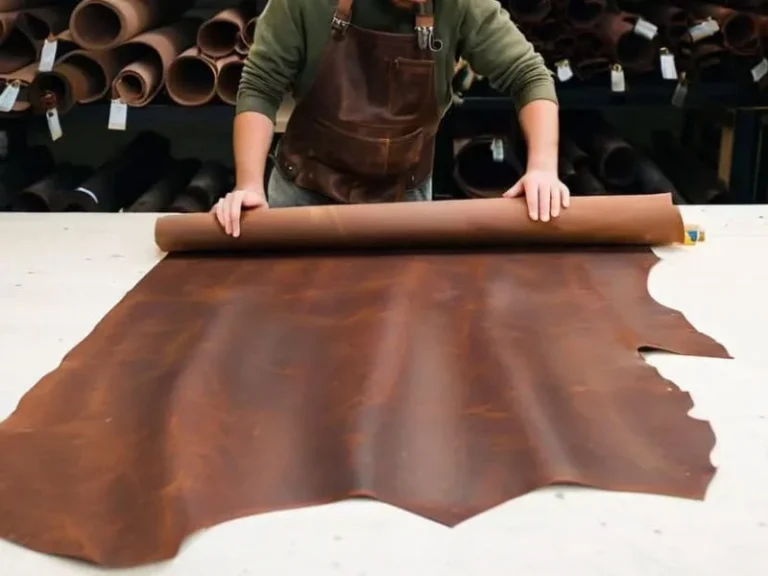
Crazy horse leather is not a species-specific hide. It is a finishing technique applied to full-grain leather. The base material is full-grain cowhide — the highest quality cut of leather, with the natural grain surface intact. This hide is then treated with a heavy application of waxes and oils worked deep into the fiber structure during the finishing process.
The result is leather with three distinguishing characteristics:
- The pull-up effect — when pressure or friction is applied, the wax redistributes and the leather lightens in color at the point of contact
- Waxy, matte surface — unlike polished leather, crazy horse leather has a natural, almost powdery texture in its resting state
- Accelerated patina development — the waxy surface accumulates character faster and more visibly than most other leather types
The Pull-Up Effect: Why Scratches Change the Color
How the Wax Sits in the Leather
During finishing, wax (and often a combination of oils) is worked into the full-grain hide at a molecular level. The wax does not sit on top of the leather like a surface coating — it permeates the fibers, filling the microscopic gaps between them and creating a unified, slightly translucent layer throughout the leather’s body.
This wax layer does two things simultaneously: it deepens the natural color of the leather, and it gives the surface its characteristic matte, slightly dusty finish.
What Happens When You Scratch It
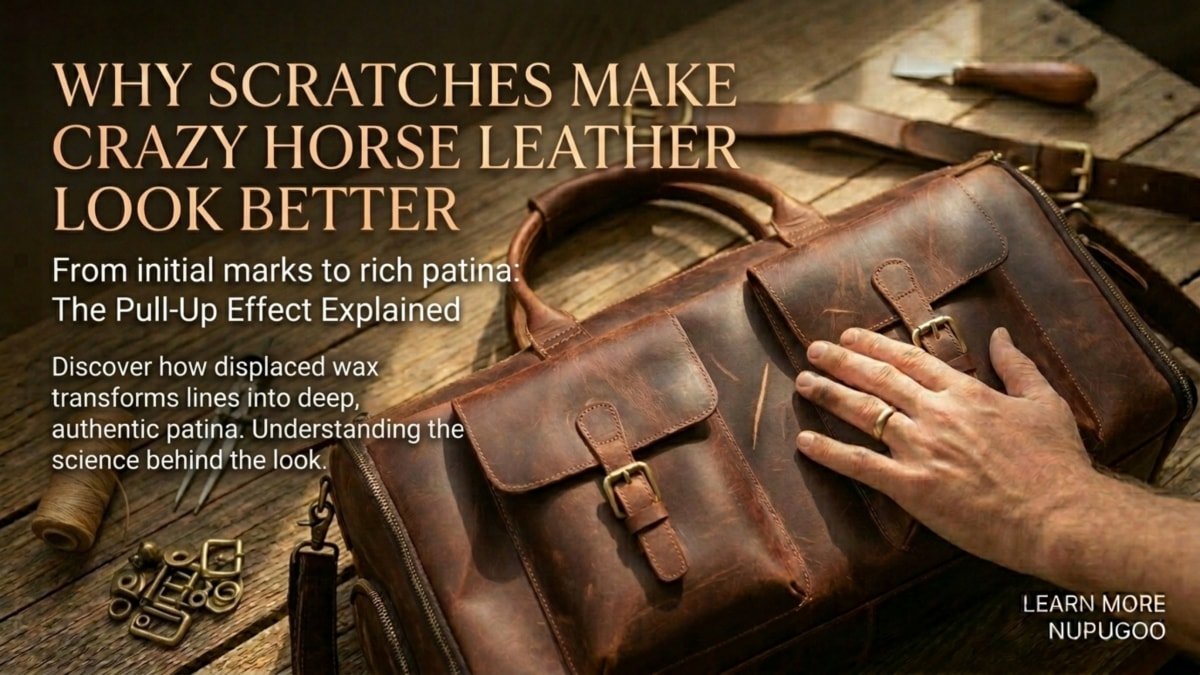
When a sharp edge, a zipper pull, a set of keys, or a rough surface contacts crazy horse leather with enough force to create friction, it does not cut the wax — it displaces it. The pressure and movement of the scratch pushes the wax away from the contact point, spreading it laterally into the surrounding fiber.
This is why the scratch looks white or pale, even though nothing has been cut or removed. The underlying leather fiber is simply less saturated with wax than the surrounding area.
Why the Scratch Can Reverse
Here is what makes pull-up leather fundamentally different from other leather types: the wax, displaced by the scratch, can be redistributed back. If you rub the scratched area with your thumb — applying friction and body heat — you push the wax back toward the contact point. The color deepens. The scratch softens. In many cases, it disappears entirely within thirty seconds.
If you leave the scratch untouched, the wax migrates back toward equilibrium on its own over days or weeks. The scratch gradually integrates into the overall surface, becoming a tonal variation rather than a distinct mark.
Either way, the scratch is temporary as a distinct line. What remains is contribution to patina — a deepening of the surface’s complexity.
The Aesthetics: Why Scratches Actually Improve the Look
The Problem with Pristine Crazy Horse
A brand-new piece of crazy horse leather is beautiful in a generic sense. The color is deep and even, the texture is consistent, and the matte finish is clean. But it could belong to anyone. It has no story. More specifically, it has not yet demonstrated the one property that defines crazy horse leather: its responsiveness to touch. A pristine piece of crazy horse leather is potential, not presence.
What Scratches Do to the Visual Field
When scratches appear on crazy horse leather and begin to integrate — not fully reversing, but transforming — they create something that designers and photographers spend enormous effort trying to replicate artificially: tonal variation at a micro scale.
The scratched areas catch light differently than the unscratched areas. The surface develops a kind of low-contrast relief — not uniform, not random, but shaped by the specific life the bag has lived. This is the same principle that makes handmade paper more beautiful than machine-made paper, that makes a well-worn tool handle more satisfying than a new one. Variation, created by authentic use, reads as richness.
The Fingerprint Phenomenon
Over time, the scratches, impressions, and touch patterns on a piece of crazy horse leather create what is effectively a fingerprint of how that specific bag has been used. Two people can buy identical bags from the same batch. After a year of different lives, those bags will be visually distinct — not because something went wrong, but because two different people lived with them.
How Scratches Build Patina on Crazy Horse Leather
Stage One: Early Scratches (Weeks 1-4)
In the first month of use, scratches on crazy horse leather are most visible and most dramatic. The contrast between the lighter scratched areas and the deeper wax-saturated background is at its maximum. These early scratches are also the most reversible — thumb-rubbing a fresh scratch often reverses it almost completely. From a visual standpoint, this stage can feel alarming. But they are the beginning of the patina development, not the end.
Stage Two: Integration (Months 1-3)
As the bag continues to be used, body oils from regular handling work into the wax layer, deepening the overall color. Earlier scratches lose their distinct edges and become absorbed into the developing surface. New scratches appear against a more complex background, making each new mark less dramatic than those that came before. The bag starts to acquire what experienced leather users describe as “depth.”
Stage Three: Full Patina (Month 6 and Beyond)
A well-used piece of crazy horse leather at six months or a year looks fundamentally different from a new piece. High-contact areas often develop a subtle sheen. Low-contact areas retain more of the original matte texture. Scratches at this stage are barely distinguishable from the general surface character.
This is the patina that crazy horse leather is prized for — and scratches are the primary instrument through which it develops.
Comparison: How Scratches Behave on Other Leather Types
| Leather Type | What Happens When Scratched | Does It Improve With Age? |
|---|---|---|
| Crazy horse (pull-up) | Wax redistributes, lighter patch appears, reverses with heat/friction | Yes — dramatically |
| Vegetable-tanned (natural) | Color lightens, fades to white fiber, darkens back over weeks | Yes — slowly |
| Full-grain aniline | Dye surface disrupted, light streak appears, partially reverses | Yes — moderately |
| Chrome-tanned pigmented | Surface coating scratched, often permanent | Rarely |
| Corrected-grain coated | Polymer surface scratched, permanent | No |
| PU / synthetic leather | Surface peels or cracks at scratch point, permanent | No |
Pull-up leathers — of which crazy horse is the most distinctive example — have the most favorable relationship with scratches. The mechanism for scratch reversal is built into the material at a structural level.
Practical Guide: Getting the Best From Your Scratches
Reverse Fresh Scratches (When You Want To)
Apply light pressure with your thumb directly over the scratch. Rub in a small circular motion for 10-20 seconds. The friction and body heat will redistribute the wax back toward the contact point. This works best on fresh scratches within a day of occurrence.
Let Older Scratches Integrate Naturally
Scratches more than a few days old have already begun natural integration. Carrying the bag and handling it regularly does more for patina integration than any direct intervention.
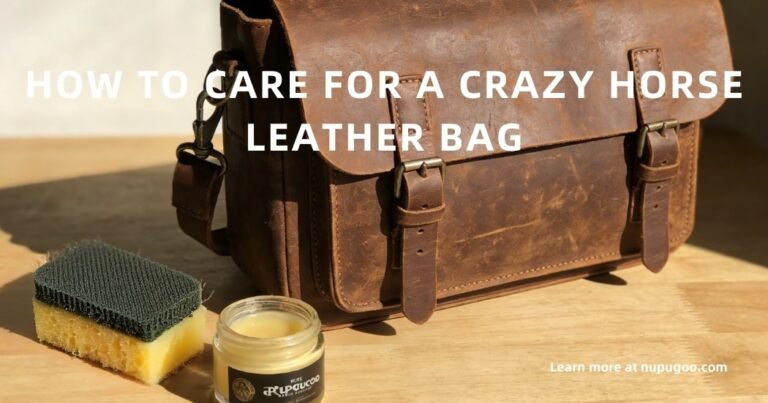
Apply Wax Sparingly to Accelerate Integration
A light application of beeswax-based conditioner, applied with a soft cloth and worked in with gentle circular pressure, re-saturates the wax layer in scratched areas. Use a very small amount — a fingernail-sized portion is sufficient for a full bag. Buff with a clean dry cloth after application.
Do Not Over-Polish
Aggressive polishing or thick conditioner layers remove the wax layer entirely, converting the surface into something that looks like regular polished leather. If you chose crazy horse for its specific visual character, protect that character by maintaining restraint in your care routine.
Frequently Asked Questions
Q: Is a scratch on my crazy horse leather bag permanent?
No — in most cases. Scratches are wax displacement events, not surface damage. They soften and integrate through normal use, and can be reduced with thumb-rubbing or light wax application.
Q: My bag arrived with scratches from shipping. Should I return it?
Probably not, unless the scratches are accompanied by structural damage. Shipping scratches on crazy horse leather are normal and will either reverse on their own or be indistinguishable from the rest of the surface within weeks.
Q: The scratch on my bag turned white. Is the leather low quality?
The opposite is true. A scratch that turns visibly pale on crazy horse leather directly demonstrates that it is genuine full-grain pull-up leather with a proper wax treatment. Cheap or synthetic leather cannot produce this response — the color-changing scratch is the authentication mark.
Q: Will my crazy horse leather bag get better or worse looking over time?
Better — provided it is used. A bag actively used for one year will be visually richer, more complex, and more beautiful than it was on the day you received it.
Q: How do I know if my leather is actually crazy horse?
Press your thumb firmly into the leather surface for three seconds, then release. On genuine crazy horse leather, the area beneath your thumb will be noticeably lighter than the surrounding surface — and will gradually darken back over the next thirty seconds.
The Final Word
A scratch on crazy horse leather is not an accident. It is not damage. It is a small-scale version of everything that makes this leather compelling.
The wax moves. The color changes. The mark integrates. The surface accumulates history.
Every scratch you put on a piece of crazy horse leather is a contribution to the only thing that makes any bag genuinely valuable: the evidence that it has been used, that it has been with you, that it is not just a product but a companion that is slowly, materially, becoming your own.
The bag you receive is the starting point. The bag you carry for a decade is the destination. Scratches are how you get there.
Explore NUPUGOO’s collection of full-grain crazy horse leather bags — built to scratch, built to change, built to last.