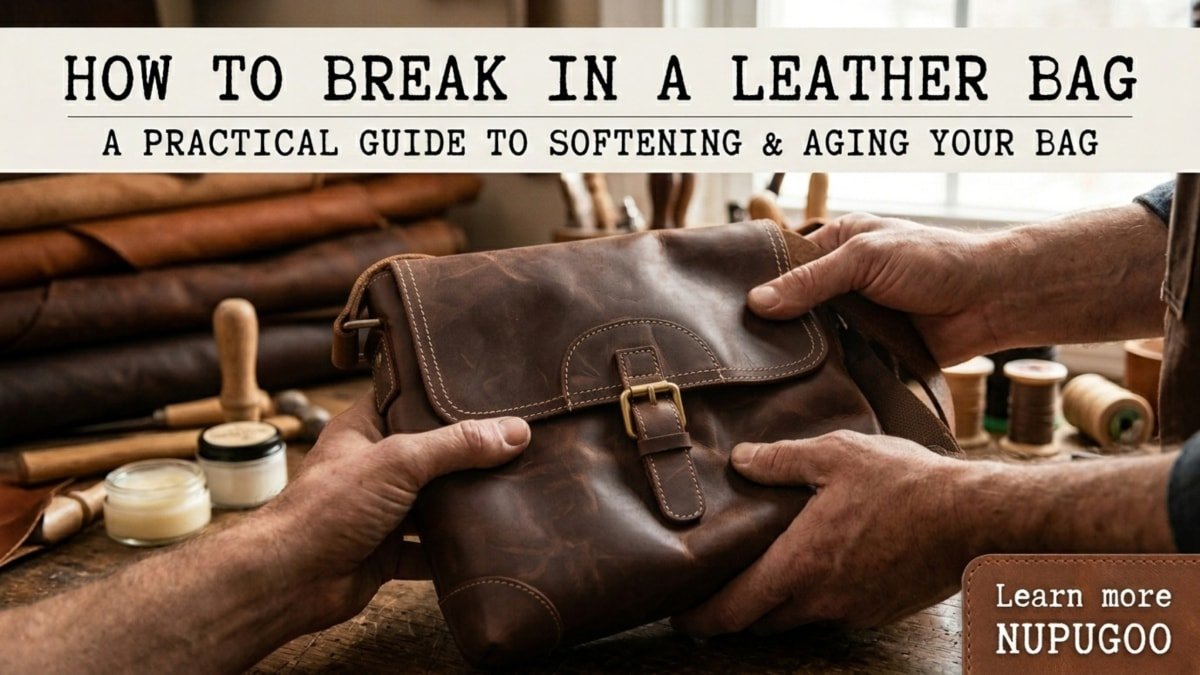
How to Break In a Leather Bag
A Practical Guide to Softening Stiff Leather — and Why the Process Matters More Than You Think
You open the box. The bag is beautiful. The leather is firm, almost rigid, and smells like a tannery on a cold morning. The straps don’t sit right. The flap doesn’t close cleanly. You knew this was coming, but you’re impatient.
Here’s the truth: a stiff leather bag is not a problem to solve. It is a process to begin.
Breaking in a leather bag is one of the most satisfying rituals in the world of quality goods — a slow transformation that, done right, produces a bag that is uniquely yours: softened in exactly the places you hold it, creased at the points that reflect your movement, worn in ways no factory could replicate.
This guide covers everything you need to know: why new leather is stiff, how to speed up the break-in without damaging the material, and how long you should realistically expect the process to take.
Why New Leather Bags Are Stiff
New leather — especially full-grain and vegetable-tanned leather — is stiff because it is still in its densest, most protected state. The tanning process compresses the fibers and locks them in place. Oils that soften and flex the material have not yet been worked in by regular use.
There are three variables that affect how stiff a new bag feels:
1. Leather Type
- Full-grain leather is the firmest new leather you can buy. The surface is untouched — no splitting, no sanding, no correction — so the original fiber density is fully intact. It will feel almost like thin cardboard in the first weeks.
- Vegetable-tanned leather is even firmer because the tanning method uses natural plant-based compounds rather than chemicals, resulting in a denser, drier fiber structure. It is the leather most commonly described as needing to be “broken in.”
- Chrome-tanned leather is softer from day one. The chemical tanning process results in a more flexible fiber structure that requires less time to break in — though it also develops less character over time.
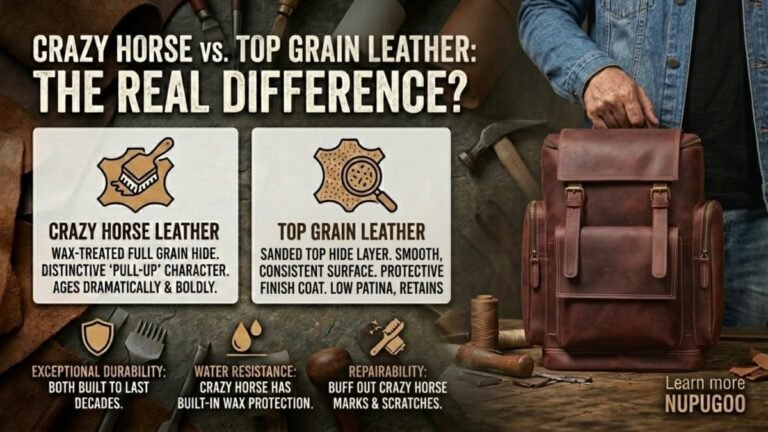
- Crazy horse leather is pull-up leather treated with waxes and oils that make it softer than pure vegetable-tan but still noticeably firmer than chrome-tanned leather. It breaks in quickly and develops a visible patina almost from the first use.
2. Thickness
Thicker leather takes longer to break in. A 3mm full-grain strap is dramatically stiffer than a 1.5mm equivalent. This is not a quality issue — it is a geometry issue. Patience is the only tool that works on thickness.
3. Construction
How the bag is assembled also affects stiffness. Double-layered panels, stiff internal structure boards, and reinforced base corners all add to the initial rigidity. Some of this will soften; some of it (intentionally) will not.
The Break-In Timeline: What to Expect
Before getting into methods, it helps to understand what a realistic break-in timeline looks like for different leather types.
| Leather Type | Expected Break-In Time |
|---|---|
| Full-grain vegetable-tanned | 4 to 12 weeks of regular use |
| Full-grain chrome-tanned | 1 to 4 weeks |
| Crazy horse / pull-up | 2 to 6 weeks |
| Oil-wax leather | 1 to 3 weeks |
| Corrected grain / pebbled | 1 to 2 weeks (less noticeable change) |
“Regular use” means carrying the bag daily or near-daily, loaded to its working weight. A bag that sits on a shelf breaks in slowly. A bag that is lived with breaks in beautifully.
Seven Methods to Break In a Leather Bag
These methods range from completely passive (just use it) to more active interventions. The right approach depends on how much time you have and how stiff the leather is.
1. Use It — Loaded
The single most effective method. Fill the bag with your everyday carry — wallet, phone, keys, water bottle, whatever the bag is designed to hold — and carry it every day. Movement, weight, and body heat do the work.
The weight is important. An empty bag doesn’t break in. The fibers need the tension created by a loaded bag to begin stretching and softening in the right places. Load it to 70-80% of its practical capacity and carry it everywhere.
Time frame: 2 to 8 weeks depending on leather type.
Risk level: Zero.
2. Work the Leather by Hand
For a faster start, spend five to ten minutes each day bending, folding, and working the leather by hand. Focus on:
- The main body panels — gently flex them back and forth
- The strap connection points — work slowly to soften the junction between strap and body
- The flap — fold it open and closed repeatedly to relax the crease
- The base corners — gently squeeze and flex the corners where two panels meet
Do not force or crease the leather in directions it isn’t designed to go. Work along the natural fold lines and stress points. Think of this as massage, not manipulation.
Time frame: Accelerates break-in by 1 to 3 weeks.
Risk level: Low. Be gentle on stitched areas.
3. Apply a Leather Conditioner
A quality conditioner — beeswax-based or a natural oil blend — introduces moisture and lubrication into the fiber structure, making the leather more flexible and receptive to movement.
How to apply:
- Clean the leather surface with a dry or barely-damp cloth to remove any dust
- Apply a small amount of conditioner to a soft cloth (not directly to the leather)
- Work it into the leather in small circular motions, covering the entire surface
- Allow it to absorb for 15 to 30 minutes
- Buff gently with a clean cloth to remove any excess
What to use: Beeswax conditioner, saddle soap, Lexol Conditioner, or Fiebing’s Leather Conditioner all work well. Avoid petroleum-based products, which can break down the fiber structure over time.
Important note: Don’t over-condition. Leather needs very little. Monthly application during the break-in period is sufficient. Over-conditioning can saturate the fibers, cause them to loosen permanently, and eliminate the firmness that makes quality bags structurally sound.
Time frame: Noticeable softening within one to two applications.
Risk level: Low, provided you use appropriate conditioner and don’t over-apply.
4. Use Heat (Carefully)
Heat accelerates the molecular movement within the leather fibers, making them more pliable. This is a useful break-in tool if handled correctly.
Safe methods:
- Carry the bag on a warm day — body heat and ambient temperature do the work gradually
- Place the bag in a warm (not hot) room for an hour before using it
- Use a hairdryer on the lowest heat setting, kept at least 20cm from the surface, moving constantly — never stationary
What to avoid:
- Direct sunlight for extended periods — this dries the leather and causes uneven fading
- Heating devices placed directly on the leather — heat guns, radiators, or steam irons
- Car interiors on hot days — the combination of heat and UV through glass causes irreversible drying and cracking
Heat is a tool, not a solution. Combined with conditioner and regular use, it speeds up the process. Used alone or aggressively, it can damage the leather permanently.
Time frame: Adds mild acceleration when combined with other methods.
Risk level: Low to moderate. Never exceed 40 degrees Celsius surface temperature.
5. Stuff the Bag Overnight
For bags with a defined structure — totes, satchels, briefcases — stuffing the bag overnight with soft materials stretches the interior panels and base, helping the leather adapt to its working shape.
How to do it:
- Fill the bag with clean, soft cloth — old T-shirts work perfectly
- Stuff it to its comfortable working capacity (not stretched)
- Leave it overnight (or for 24 to 48 hours in a dry environment)
- Combine with a light conditioner application before stuffing for faster results
Time frame: One to two overnight sessions noticeably loosen the structure.
Risk level: Very low. Do not overstuff beyond the bag’s natural capacity.
6. Rub with a Dry Cloth
The friction from rubbing a dry lint-free cloth over the surface — the same motion you would use to polish a shoe — generates mild heat and mechanical pressure that begins to soften surface fibers and work natural oils toward the top of the leather.
This is a good daily habit for the first month. It is also how you develop the surface sheen that gives aged leather its characteristic glow without any product at all.
Time frame: Cumulative effect over weeks.
Risk level: Zero.
7. Wear It In Layers
For shoulder bags and crossbody styles, wearing the bag against different clothing layers affects how the strap softens. Against a thick winter coat, the strap barely flexes. Against a light summer shirt, the bag moves constantly and the strap works through its full range of motion.
If you need to break in the strap quickly, wear the bag against a light layer and move actively — not just walking but climbing stairs, bending, and carrying the bag in different positions.
Time frame: Strap softens notably within two to four weeks of summer/light-layer use.
Risk level: Zero.
What Not to Do
A few break-in approaches that regularly appear online are worth specifically addressing because they can damage leather.
Do not soak the leather in water. Water temporarily softens leather by displacing the oils in the fibers. But as it dries, it draws those oils out of the leather entirely, leaving it drier, stiffer, and more prone to cracking than before. It can also cause irreversible water staining and tide marks on untreated leathers.
Do not apply olive oil, coconut oil, or vegetable cooking oils. These oils can soften leather in the short term but go rancid inside the fibers over time, causing an unpleasant odor and potentially affecting the leather’s structural integrity. Stick to purpose-formulated leather products.
Do not machine wash or tumble dry. Even “gentle” machine washing cycles will destroy the internal structure of most leather bags and cause shrinkage, delamination, and permanent warping.
Do not leave the bag in the freezer. This approach — sometimes suggested for shoes — has no credible benefit for bags and can cause the fiber structure to become brittle and crack when it returns to room temperature.
How to Know When the Break-In Is Complete
There is no single moment when a leather bag is “fully broken in.” It is a gradient, not a destination.
But there are markers that tell you the main phase is over:
- The bag opens and closes smoothly without effort
- The strap sits comfortably on your shoulder without digging
- The body panels flex and return rather than holding their creased position
- The leather has developed a visible surface sheen or color depth in high-touch areas
- The bag has begun to mold to the shape of your contents
When these things have happened, the break-in phase has given way to something better: the aging phase. This is the long, slow accumulation of patina that continues for the life of the bag. The break-in is the beginning — the aging is the story.
Caring for Your Bag During the Break-In Period
Keep it away from rain in the first month. Unbroken leather absorbs water more readily than aged leather. A quick shower is not catastrophic, but prolonged exposure before the fibers have been worked in can cause tide marks and uneven darkening.
Don’t clean it aggressively. Mild surface dirt can be removed with a slightly damp cloth. Save the saddle soap for when it’s genuinely needed.
Store it stuffed. When you’re not using the bag, stuff it lightly to help it hold its shape. A stuffed bag maintains the work you’ve done during break-in.
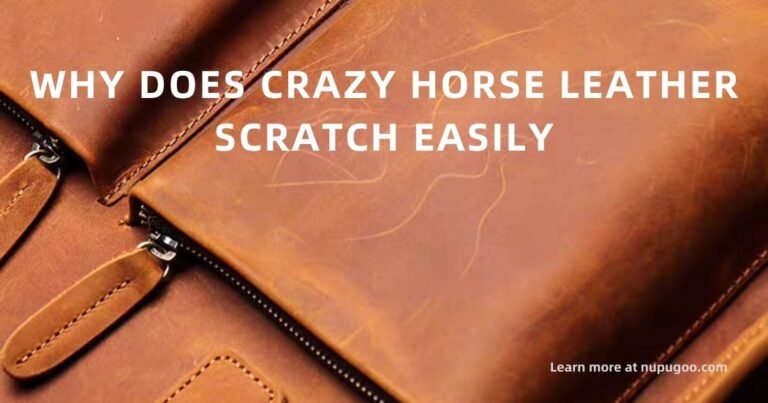
Let scratches happen. During break-in, scratches are expected and desirable. They blend into the developing patina and become part of the bag’s character. Don’t try to prevent them.
Frequently Asked Questions
Q: My new bag feels like cardboard. Is something wrong with it?
No — especially if it is full-grain or vegetable-tanned leather. Firmness is a characteristic of quality, unprocessed leather, not a defect. Give it four weeks of regular use combined with one or two conditioner applications, and you will barely recognize it.
Q: Can I speed up the process without damaging the leather?
Yes — the combination of daily use (loaded), hand-working the key stress points, and one light conditioner application will produce noticeable softening within two to three weeks for most leather types.
Q: I conditioned my bag but it’s still stiff. What should I do?
Conditioning alone rarely softens a very firm bag dramatically. It prepares the fibers for movement but doesn’t replace movement. Use the bag daily, loaded, for two to three weeks, and the stiffness will reduce much faster.
Q: Should I break in a bag before traveling with it?
Ideally, yes. A partially broken-in bag conforms to your body and carries more comfortably than a brand-new stiff one. If you’re traveling soon after purchase, do the stuffing method and one conditioner application in the days before departure, then carry the bag throughout the trip — nothing breaks in a bag faster than airport days.
Q: Will my bag lose its structure during break-in?
Quality leather bags are built with structural elements — internal boards, reinforced base pieces, and layered construction — that retain their shape even as the outer leather softens. The bag becomes more comfortable without becoming floppy. If a bag completely loses its shape during normal break-in, it either was not well-constructed or was over-conditioned.
Final Thoughts
Breaking in a leather bag is not a chore. It is one of the few interactions you can have with an object that genuinely improves it.
The bag you carry at the end of three months of real use is a better bag than the one that arrived in the box. It fits your shoulder. It opens at the angle you grip it. It smells of leather and light and everything you’ve carried in it. The stiff shell has become your companion.
Quality leather was never meant to be new. It was meant to be used, worked, and worn — until it becomes the kind of bag someone points to and says: that’s a good bag.
Start today. Fill it up. The leather is waiting.
Browse NUPUGOO’s full range of full-grain and crazy horse leather bags — built stiff, designed to age, and made to be yours.