Vegan Leather vs Genuine Leather: The Honest Difference Explained
An honest comparison between two very different materials that share one name
Why This Comparison Matters
Walk into any bag shop — online or offline — and you will see both types of product described as “leather.” A vegan leather tote sits next to a genuine leather messenger bag. The prices are different. The surface textures look almost identical. The marketing copy for both is glowing.
So what is actually going on?
This article is not a hit piece on vegan leather. There are real reasons to choose it. But there are also things the vegan leather industry tends not to say out loud, and things the genuine leather industry does not always explain clearly. By the end of this piece, you will know the actual difference between the two materials, what each one does well, and what each one cannot do no matter how well it is made.
What Vegan Leather Actually Is
“Vegan leather” is a marketing term, not a material. It describes any non-animal material designed to look or feel like leather. The two most common types are:
PU leather (polyurethane): A fabric base — usually polyester — coated with a layer of polyurethane foam and a surface finish. This is what most vegan bags are made of. It is inexpensive to produce, easy to dye, and can be made to look convincingly like leather at first glance.
PVC leather (vinyl): An older formulation using a PVC coating instead of polyurethane. Stiffer, less breathable, and generally considered lower quality than PU. Still widely used in lower-price-point products.
Newer bio-based materials: Apple leather, cactus leather, mushroom leather, and similar products are real and in development. They represent a genuine attempt to improve on PU/PVC. But they are not widely used in mainstream bags yet, and long-term durability data is limited.
When a bag is labeled “vegan leather” without further specification, it is almost certainly PU or PVC.
What Genuine Leather Actually Is
Genuine leather comes from animal hides — primarily cattle — that have been tanned to stop decomposition and create a stable, workable material. The hide is a dense, three-dimensional fiber network that took years to grow. Tanning preserves and stabilizes that structure.
The quality of leather varies enormously based on which part of the hide is used:
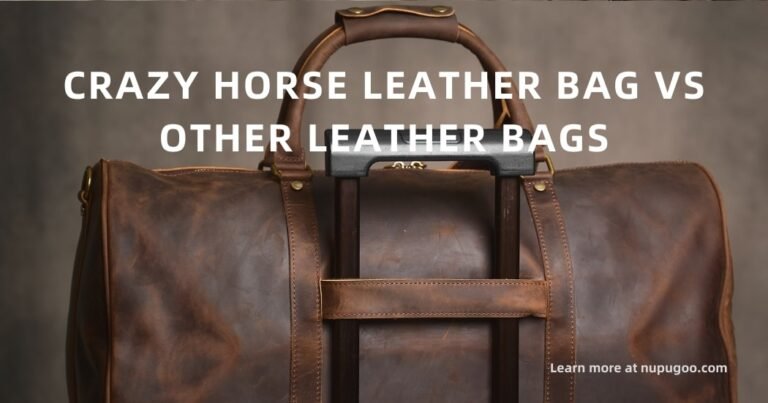
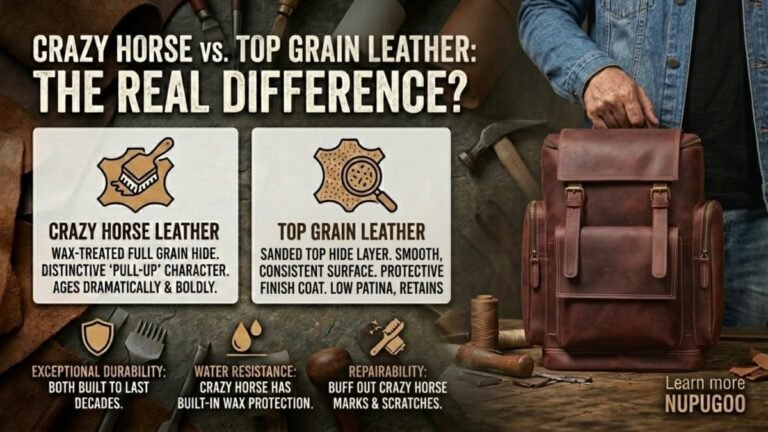
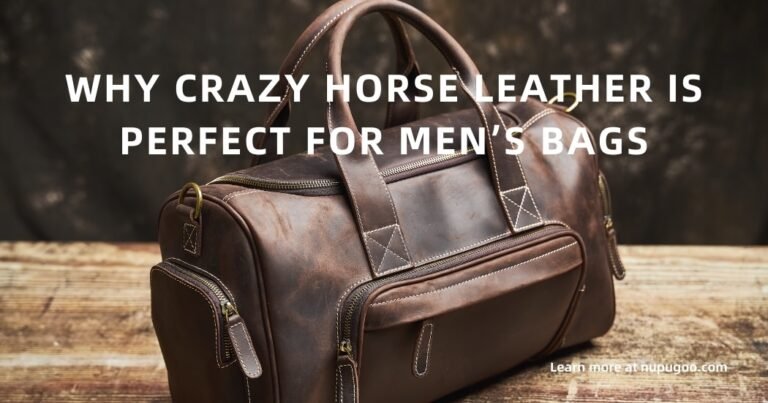
Full-grain leather: The outermost layer of the hide, with the full fiber structure intact and the natural surface visible. The densest, most durable, and most expensive type. It develops a patina over time. Crazy horse leather is made from full-grain leather.
Top-grain leather: The surface layer is sanded and buffed to remove imperfections, then finished with a uniform coating. More consistent in appearance than full-grain but slightly less durable. Used in most mid-range genuine leather products.
Split leather (suede, bonded leather): Made from the inner layers of the hide after the top grain has been separated. Significantly less durable. Bonded leather uses shredded leather fibers mixed with adhesive — it looks like leather but behaves more like cardboard laminate.
A label that says “genuine leather” only tells you it came from an animal. It does not tell you where on the hide or how it was processed. The term covers everything from full-grain to bonded.
What Vegan Leather Does Well
Let’s be straightforward about this.
Consistency of appearance. PU leather is manufactured under controlled conditions. The color, texture, and grain pattern are perfectly uniform. If you want a bag in a specific color with no surface variation, vegan leather delivers that reliably. Full-grain leather has natural marks, grain variation, and subtle color differences. That is part of its character, but not everyone wants it.
Lower entry price. A well-made PU leather bag costs less to produce than a well-made genuine leather bag. For someone who wants the look of leather without the price, vegan leather is a practical choice.
No animal products. For people who avoid animal products for ethical or environmental reasons, vegan leather addresses the animal welfare side of the equation. This is a real consideration and not a minor one.
Easier care. PU leather does not need conditioning, does not react to water in the way genuine leather does, and can often be wiped clean with a damp cloth. Less maintenance.
Color range. PU leather can be produced in almost any color, including colors that would be difficult or impossible to achieve with natural leather dyes. Neon, metallics, pastels — all straightforward with PU.
What Vegan Leather Cannot Do
This is where the honest conversation gets uncomfortable for the vegan leather industry.
It does not last.
PU leather has a lifespan problem that is structural, not cosmetic. The polyurethane coating that gives PU leather its appearance begins to break down over time — typically 3 to 5 years of regular use. The surface starts to peel, crack, or flake. Once that process starts, it cannot be stopped or reversed. There is no conditioning product, no restoration treatment, and no repair that fixes delaminating PU leather. The bag is finished.
The underlying reason is chemistry. Polyurethane is a plastic. Plastics degrade through UV exposure, heat, humidity, and simply through the repeated stress of use. The breakdown is not a defect in any individual bag — it is a property of the material itself.
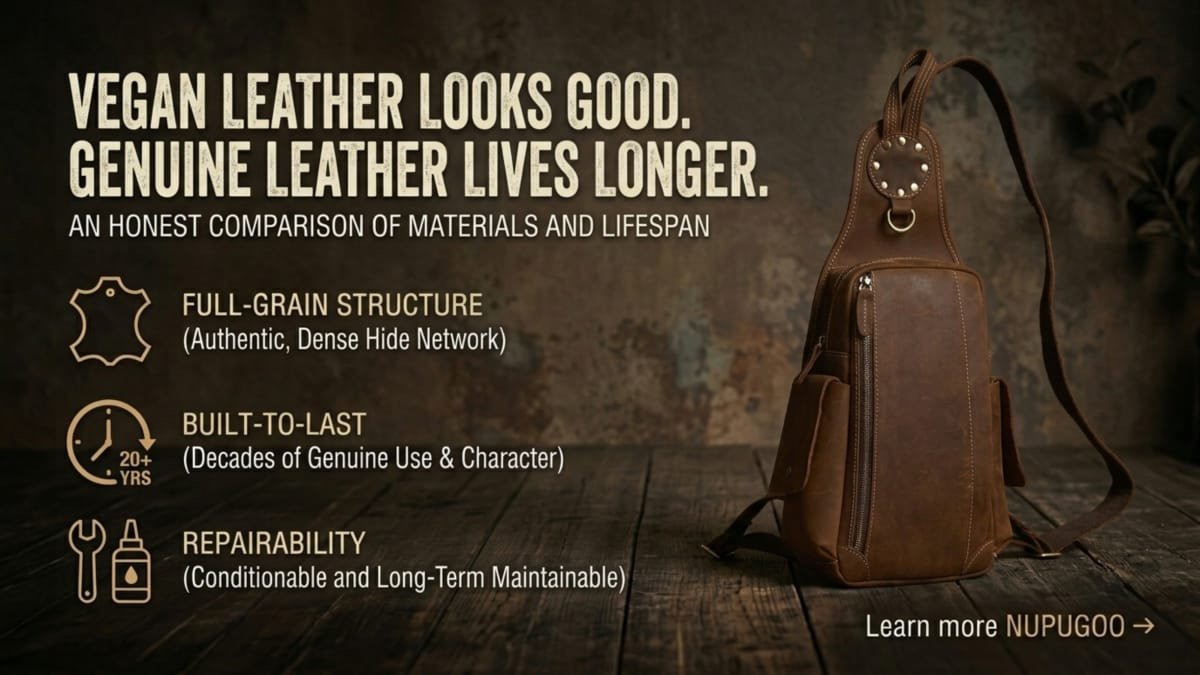
Full-grain genuine leather, by contrast, is not a coating. It is a continuous fiber structure through its entire thickness. When the surface of genuine leather is scratched, that scratch can often be rubbed out. When the surface dries out, conditioning restores it. The material does not delaminate because there is no separate layer to separate. A well-maintained full-grain leather bag does not have a 5-year lifespan. It has a 20- to 30-year lifespan, or longer.
It does not age well.
This is connected to durability but distinct from it. Genuine leather changes with use in ways that generally improve its appearance. The surface develops a patina — a darkening and deepening of color that comes from oils absorbed over time. Creases and wear marks become part of the character of the bag. A 10-year-old genuine leather bag in good condition often looks better than a new one.
Vegan leather does not develop a patina. It can develop surface scuffs and wear marks, but these do not become more attractive over time. They are just damage. A 5-year-old PU leather bag in average condition looks like a 5-year-old plastic bag.
It is not straightforwardly better for the environment.
This claim gets made frequently, and it deserves scrutiny. PU leather is a petroleum-based product. Manufacturing it generates chemical waste. It is not biodegradable in any meaningful timeframe. When a PU leather bag reaches the end of its 3-to-5-year life, it goes to landfill.
Genuine leather production also has environmental costs — primarily from cattle farming, which is a significant source of greenhouse gas emissions, and from the chemical processes involved in tanning.
Neither material has a clean environmental record. But the lifecycle math is more complicated than “vegan = good, animal = bad.” A genuine leather bag used for 25 years has a very different environmental footprint per year of use than a vegan leather bag replaced every 4 years. The shorter the product lifespan, the more often it needs to be manufactured, transported, and disposed of.
A Direct Comparison
| Vegan Leather (PU) | Genuine Full-Grain Leather | |
|---|---|---|
| Initial appearance | Very consistent, uniform | Natural variation, surface marks |
| Price | Lower | Higher |
| Lifespan | 3–5 years | 20–30+ years |
| Failure mode | Peeling and delamination | Drying, cracking (preventable with care) |
| Repairability | Not repairable once peeling begins | Scratches, drying, minor damage all treatable |
| Patina / aging | Does not develop patina | Develops character over time |
| Maintenance | Low — wipe clean | Requires occasional conditioning |
| Water resistance | Moderate by default | Lower, but treatable with waterproofing products |
| Environmental footprint | Petroleum-based, non-biodegradable | Animal-derived, biodegradable, complex lifecycle |
| Feel over time | Softens slightly, then degrades | Softens and conforms to use patterns |
The Crazy Horse Leather Difference
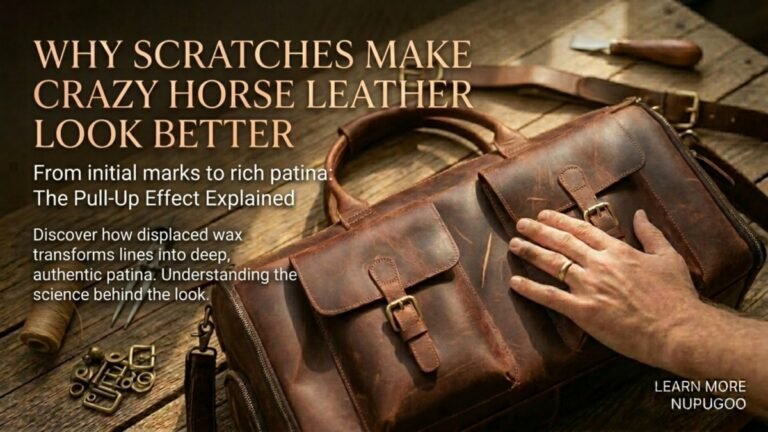
Among genuine leathers, crazy horse leather sits at a specific point on the spectrum. It is full-grain leather treated with a wax or oil finish that fills the surface pores and creates a characteristic color-shift effect — press a fingernail against the surface and the area around the pressure turns lighter. That is the wax displacing in the fiber structure.
The wax treatment does several things beyond aesthetics. It provides natural water resistance without the need for separate waterproofing products. It makes the surface more resistant to minor abrasions. It slows the rate at which the leather dries out between conditionings.
Over time, crazy horse leather develops a particularly rich patina. The color deepens. The texture changes. Scratches fade or become part of the surface character rather than visible damage. The bag looks used in the way that a well-worn leather jacket looks — authentically, attractively used.
This is the specific type of aging that no synthetic material replicates, because it cannot. The process requires a biological material with a three-dimensional fiber structure that absorbs oils, distributes stress, and responds to handling over years. PU leather is a flat plastic coating on a fabric backing. It does not have the structure to do any of that.
When Vegan Leather Makes Sense
There are situations where choosing vegan leather is the right decision.
If your budget does not allow for a genuine leather bag in the quality range you want, a good PU leather bag is a reasonable option for 3 to 4 years of use. It is better than a cheap genuine leather bag made from split or bonded leather.
If you avoid animal products entirely, that is a coherent and consistent value. The environmental argument for vegan leather is more complicated than it appears, but the animal welfare argument is straightforward.
If you want a specific color or finish that is not available in genuine leather, PU leather may be your only option.
If you are buying a bag for occasional use — a few times per year — the lifespan difference matters less. PU leather can last a long time under light use.
When Genuine Leather Makes Sense
If you carry a bag every day, genuine leather’s lifespan advantage compounds quickly. The cost-per-year of ownership favors genuine leather significantly when you factor in replacement frequency.
If you care about the appearance of your bag improving over time rather than degrading, genuine leather is the only material that achieves this.
If you want something repairable, conditionable, and maintainable — a bag you can keep in good condition through active care — genuine leather is the option with that possibility.
If you are buying a bag as a long-term purchase rather than a seasonal item, genuine leather is the appropriate material for that intention.
What We Make at NUPUGOO
At NUPUGOO, we work exclusively with full-grain crazy horse leather. We make bags for people who want to buy one bag instead of several, who find the aging process of genuine leather appealing rather than inconvenient, and who treat their bag as an investment rather than a seasonal item.
That is a specific use case. It is not the right choice for everyone. But for the person who wants a bag that will look better in 10 years than it does on the day they buy it, crazy horse leather is the material that delivers that.
Vegan leather looks good on day one. We are not going to tell you it does not.
Genuine leather looks better on day 3,650.