Are Crazy Horse Leather Bags Worth It?
The honest answer — pros, cons, hidden costs, and who should (and shouldn’t) buy one
Introduction
You’ve seen the photos. A rugged messenger bag with a surface that looks like it has already lived a life — charcoal grey leather marked with lighter streaks, edges that seem to glow, a bag that looks vintage the day it arrives.
Then you see the price tag. It’s not cheap. And you’re wondering: is this worth it, or am I paying a premium for marketing?
This is the question we hear more than any other at NUPUGOO. And the honest answer is: it depends — but in a very specific way.
This article breaks down exactly what you’re paying for when you buy a crazy horse leather bag, where the hidden costs are, how it compares to other leather types, and — most importantly — whether it fits your actual life, not the life you imagine having.
First: What “Crazy Horse” Actually Means
Before talking about value, we need to be clear about what you’re buying.
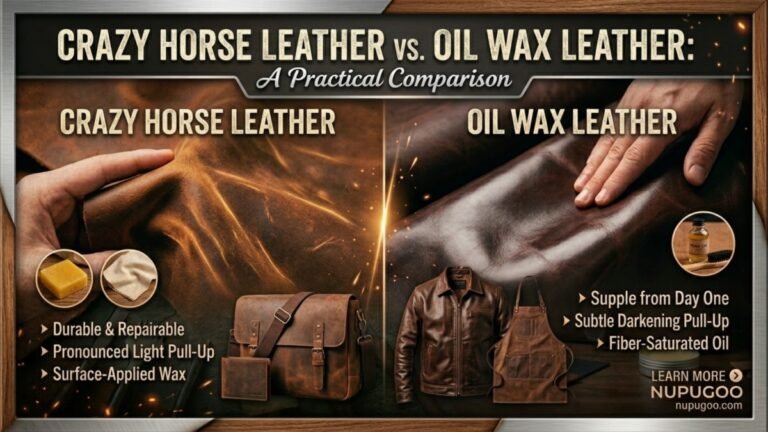
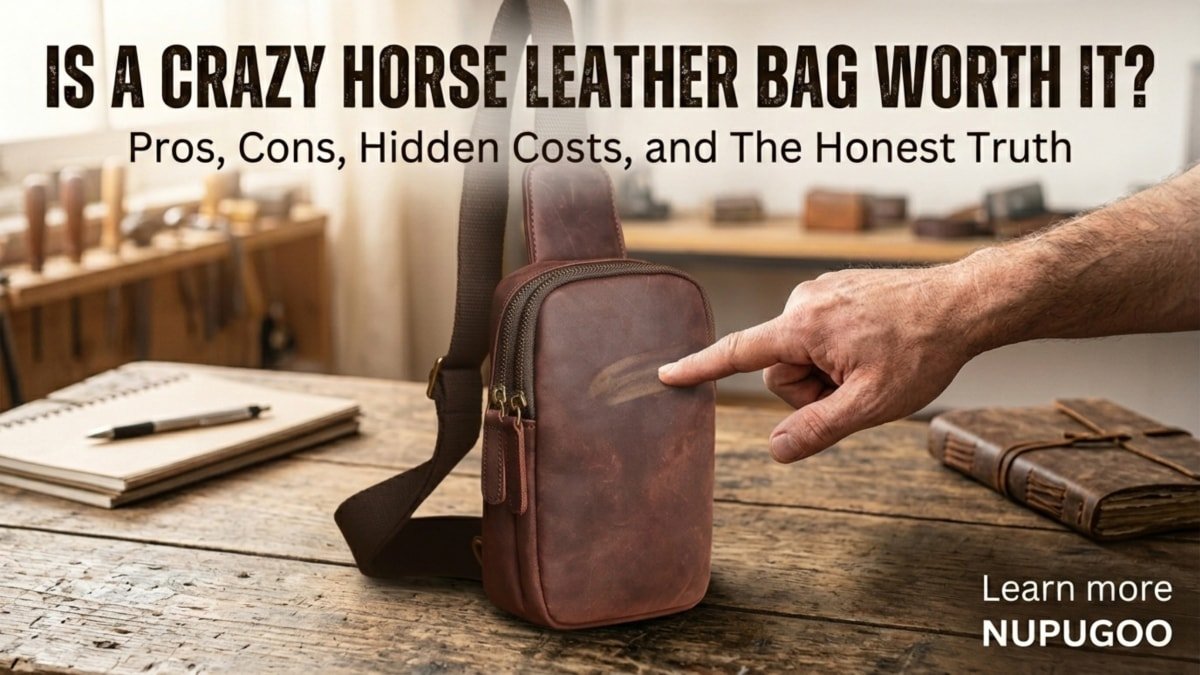
“Crazy horse leather” is not a breed of animal. It is cowhide (usually full-grain) that has been treated with a special process: a layer of wax and oil is pressed into the surface of dyed leather. The result is a material that changes color when you touch it — press your thumb into the leather and the oils shift, creating a lighter mark. Walk away and the mark fades slightly, but never completely disappears.
This is called the pull-up effect, and it is the defining feature of crazy horse leather.
The name itself is marketing — “crazy horse” sounds rugged and Western, but the leather has no historical connection to horses. What matters is the performance: this is leather that is designed to show wear, and that changes everything about its value proposition.
The Case FOR Crazy Horse Leather
Let’s start with what makes these bags genuinely worth the money for the right buyer.
1. You Get “Instant Vintage” — Without Waiting Years
Full-grain vegetable-tanned leather is the gold standard for longevity, but it takes 6 to 12 months of daily use to develop a meaningful patina. Crazy horse leather gives you 50% of that character on day one. The wax coating creates surface variation that looks like aged leather, and every time you pick up the bag, you add new marks.
If you want a bag that looks like it has a story, but you don’t want to wait three years for the story to appear, crazy horse leather is the shortcut that doesn’t feel like a compromise.
2. Scratches Don’t Ruin It — They Improve It
With most leather (and virtually all non-leather bags), a scratch is damage. With crazy horse leather, a scratch is part of the design. The pull-up effect means that surface marks blend into the overall character of the bag rather than standing out as flaws.
This has a real-world benefit: you stop worrying about the bag. The day you stop babying your bag is the day you actually start using it. For many people, that psychological shift is worth the price alone.
3. It Is Genuinely Durable
Under the wax and oil layer, crazy horse leather is still full-grain cowhide — the strongest, most durable leather available for bags. The wax coating adds a degree of water resistance (not waterproof, but enough to handle a brief rain). The oil keeps the fibers flexible so the leather is less prone to drying and cracking than untreated vegetable-tanned leather.
A well-made crazy horse leather bag will easily last 10 to 15 years of daily use. Break that down by cost-per-day and the math starts to look very reasonable.
4. It Ages in a Visible, Satisfying Way
This is subjective, but it matters. Cheap bags look worse with age. They fray, the coating peels, the hardware tarnishes. A crazy horse leather bag looks better with age — the wax smooths out, the surface darkens and evens, the edges polish themselves through handling.
If you appreciate the idea of a bag that records your life rather than just carrying your things, this is one of the few bag types that delivers that experience.
5. It Is Low Maintenance
Unlike full-grain vegetable-tanned leather (which needs regular conditioning) or suede (which needs protection spray and careful storage), crazy horse leather is low drama. A quick wipe with a damp cloth is usually enough. Condition it once or twice a year and it will be fine.
For someone who wants a leather bag without the leather-care hobby, this matters.
The Case AGAINST Crazy Horse Leather
Now the part most brands won’t tell you.
1. It Shows Every Mark — Including the Ones You Don’t Want
The same property that makes scratches “disappear” also means that oil from your hands, denim transfer, and ink marks will all show up on the surface. If you rest the bag against a freshly painted wall, it will leave a mark. If you set it on a dirty floor, it will show.
You cannot “fix” these marks in the way you can polish a scuff on smooth leather. You have to accept them as part of the bag’s character.
The bottom line: If you are the kind of person who stresses about keeping things pristine, crazy horse leather will make you anxious.
2. Color Options Are Limited
Because of the wax and oil treatment, crazy horse leather is almost always produced in darker, earthier tones — browns, charcoals, olives, dark blues. The process doesn’t work well with very light colors or bright hues.
If you want a tan bag that stays tan, or a pastel-colored bag, crazy horse leather is not the right choice.
3. It Can Look “Messy” If You Don’t Like the Aesthetic
This is personal taste, but it needs saying: crazy horse leather has a rough, uneven, distressed look. Some people love it. Some people think it looks like the bag is dirty or damaged.
If your workplace or social circle leans formal, a heavily distressed crazy horse leather bag can look out of place. It signals “workshop” and “weekend,” not “boardroom.”
4. Not All “Crazy Horse” Leather Is Created Equal
This is the hidden trap. Because “crazy horse” is a marketing term, not a technical specification, any brand can use it to describe any leather that has been oiled and waxed. We have seen:
- Genuine leather (split leather) marketed as crazy horse — this is leather with the surface sanded off and coated with heavy wax to fake the pull-up effect. It will not last.
- Bonded leather with a crazy horse-style coating — this is leather dust glued together. It will disintegrate within 2 years.
- Thin crazy horse leather (1.2mm or less) marketed as “lightweight” — it will stretch and lose shape quickly.
The test: If a crazy horse leather bag costs less than $80–$100, be very suspicious. Real full-grain crazy horse leather at a reasonable thickness (1.5–2.0mm) has a material cost that makes ultra-cheap pricing impossible.
5. Wax Can Transfer to Clothing
In the first few weeks of use, the wax coating on crazy horse leather can rub off on light-colored clothing. It is not permanent and usually washes out, but it is annoying.
This diminishes significantly after the first month as the excess wax gets rubbed off through normal handling.
The Real Cost Breakdown
Let’s talk numbers. What should you actually expect to pay?
| Price Range | What You’re Getting | Worth It? |
|---|---|---|
| Under $60 | Almost certainly not full-grain leather. Likely split leather or bonded leather with a heavy wax coating. | ❌ No |
| $60–$120 | Possible full-grain, but likely thinner leather (1.2–1.5mm) and/or lower-quality hardware. Can be decent value if you verify the specs. | ⚠️ Maybe |
| $120–$250 | The sweet spot. Full-grain leather, 1.5–2.0mm thickness, decent hardware (YKK zippers, solid brass/metal fittings). | ✅ Yes |
| $250–$500 | Premium brands. You are paying for brand name, possibly better construction (hand-stitching, premium lining), and design. The leather quality is not necessarily better than the $120–$250 tier. | ⚠️ Depends on priorities |
| $500+ | Luxury tier. You are paying for the brand, not the leather. The bag may be beautiful, but the price-to-durability ratio is poor. | ❌ Generally no |
Crazy Horse vs. The Alternatives
How does crazy horse leather compare to other common bag materials?
vs. Full-Grain Vegetable-Tanned Leather
| Crazy Horse | Vegetable-Tanned | |
|---|---|---|
| Look on day one | Distressed, vintage | Clean, uniform |
| Patina development | Fast (weeks) | Slow (months to years) |
| Maintenance | Low | Moderate (regular conditioning) |
| Water resistance | Moderate (wax coating) | Low (needs treatment) |
| Price | Moderate | Moderate to high |
| Best for | People who want character without the wait | Purists who want “real” leather aging |
vs. Chrome-Tanned Leather
| Crazy Horse | Chrome-Tanned | |
|---|---|---|
| Aging | Develops character | Stays the same or looks worn |
| Durability | 10–15 years | 5–10 years |
| Feel | Firm, structured | Soft, flexible |
| Price | Moderate | Low to moderate |
| Best for | Long-term daily use | Fashion bags, occasional use |
vs. Canvas / Nylon
| Crazy Horse Leather | Canvas / Nylon | |
|---|---|---|
| Durability | 10–15 years | 3–7 years |
| Appearance | Ages beautifully | Looks worn/stained |
| Water resistance | Moderate | High (nylon) / Low (canvas) |
| Weight | Heavier | Lighter |
| Price | Higher | Lower |
Who Should Buy a Crazy Horse Leather Bag?
You SHOULD buy one if:
- ✅ You want a bag that looks better the more you use it
- ✅ You don’t want to baby your belongings
- ✅ You appreciate the look of distressed, vintage-style leather
- ✅ You plan to use the bag daily for work, commuting, or travel
- ✅ You want a bag that will last a decade or more
- ✅ You don’t mind (or actively enjoy) the marks and scratches that come with use
- ✅ You want low-maintenance leather that doesn’t need constant conditioning
You should NOT buy one if:
- ❌ You want a bag that stays looking exactly the same as the day you bought it
- ❌ You work in a very formal environment where a distressed look is inappropriate
- ❌ You are very particular about keeping your belongings pristine
- ❌ You want a light-colored bag that stays light-colored
- ❌ You are shopping primarily on price and want the cheapest option
- ❌ You don’t actually carry much day-to-day (a leather bag that sits on a shelf ages poorly — leather needs to be used)
The Hidden Question: Is the Bag Well-Made?
Even if crazy horse leather is right for you, the leather is only half the story. A bag is only as good as its construction.
When evaluating any crazy horse leather bag, check these five things:
1. Stitching
Is the stitching straight and even? Are there any loose threads? Double-stitched stress points (where the strap meets the bag, where the handle attaches) are a sign of quality.2. Hardware
Open and close the zippers. Do they glide or resist? YKK is the industry standard for a reason. If the brand doesn’t specify the hardware, be suspicious. Cheap zippers are the #1 reason bags get discarded while the leather is still fine.3. Lining
Reach inside. Is there a lining or is it bare leather? A fabric or leather lining protects the inside of the bag and gives it structure. No lining is not necessarily bad, but it changes the experience.4. Strap Attachment
How are the straps attached? Rivets plus stitching is the gold standard for stress points. Rivets alone can loosen; stitching alone can tear. Both together is what you want to see.5. Weight
A proper full-grain leather bag should feel substantial. If it feels oddly light, the leather may be thinner than it should be.The NUPUGOO Perspective
We make crazy horse leather bags because we believe they hit the sweet spot between quality, character, and practicality.
We are not interested in convincing everyone to buy one. If you want a bag that looks brand-new on day 1000, our bags are not for you. But if you want a bag that records your life — the commute, the travel, the daily carry — and looks better for having done so, we think crazy horse leather is one of the best materials ever developed for bags.
Our bags use full-grain cowhide, 1.6–1.8mm thick, with YKK zippers and reinforced stress points. We price them fairly because we want you to actually use the thing, not keep it on a shelf.
Final Verdict: Is It Worth It?
Yes — with three conditions:
1. You buy a bag made with real full-grain leather. Check the specs. If the brand can’t tell you the leather type and thickness, walk away.
2. You actually like the aesthetic. Don’t talk yourself into a distressed look because it’s “rugged.” Make sure you genuinely like how it looks.
3. You will use it. A $200 leather bag that gets daily use is a better value than a $40 canvas bag that falls apart in three years. But a $200 leather bag that sits on a shelf is a waste of money.
If those three things are true for you, a crazy horse leather bag is not just worth it — it might be the last bag of this type you need to buy.
Quick FAQ
Q: Will the marks ever go away completely?
A: No, and that’s the point. They fade and blend, but they don’t disappear. That’s what creates the patina.
Q: Can I speed up the aging process?
A: You can, but we recommend letting it happen naturally. Forced aging (like rubbing the leather with sandpaper or conditioning it heavily) looks artificial. The best patina comes from actual use.
Q: What if I don’t like the distressed look after a few months?
A: This is why we recommend living with the decision for a bit before buying. Look at photos of crazy horse leather bags after 6 months of use. If you don’t like what you see, this leather type is not for you.
Q: Is crazy horse leather real leather?
A: Yes — real full-grain cowhide that has been treated with wax and oil. The confusion comes from the name, which sounds like a synthetic material.
Q: How do I know if I’m buying a good one?
A: Price is a rough guide ($120+ for a proper bag), but also check: leather type (full-grain), thickness (1.5mm+), hardware brand (YKK or equivalent), and construction (double-stitched stress points).
Written by the NUPUGOO team. We make full-grain crazy horse leather bags that are built for the long haul — and designed to look better every year you carry them.