
Debossed vs Embossed Leather: What Each One Actually Looks Like
The terminology is inconsistent everywhere. Here is what the words mean and which one you probably want.
Why This Is Confusing
“Embossed” and “debossed” both appear on product listings, in manufacturer specifications, and in how-to guides — often used interchangeably, sometimes incorrectly, and occasionally with the same product described as both. If you have ever ordered a “custom embossed” leather item and received something slightly different from what you expected, the terminology confusion is probably why.
Here is what each word actually means.
Embossed: The Design Stands Up
Technically, embossing means the design is pressed upward — it stands above the surrounding surface. This is done by pressing the leather against a die from below, so the metal forces the leather fibers upward to create a raised relief.
The result is three-dimensional in a specific way: the design elements that are meant to be prominent actually stick out from the surface plane. Run your finger across an embossed design and you feel it rising toward you.
Embossing is common in leather goods with decorative elements — raised floral patterns, raised crests, raised borders. It is also the technique used for the raised lettering you sometimes see on the spines of luxury books, on certain wallet corners, or on formal stationery.
On bags, raised embossing is most often used for decorative motifs rather than text or monograms, because raised letterforms are more vulnerable to wear than recessed ones — the high points of the design absorb friction first.
Debossed: The Design Goes In
Debossing is the reverse: the design is pressed downward, into the leather surface. The die presses from above, compressing the leather fibers to create a recessed impression. The design sits below the surrounding surface plane.
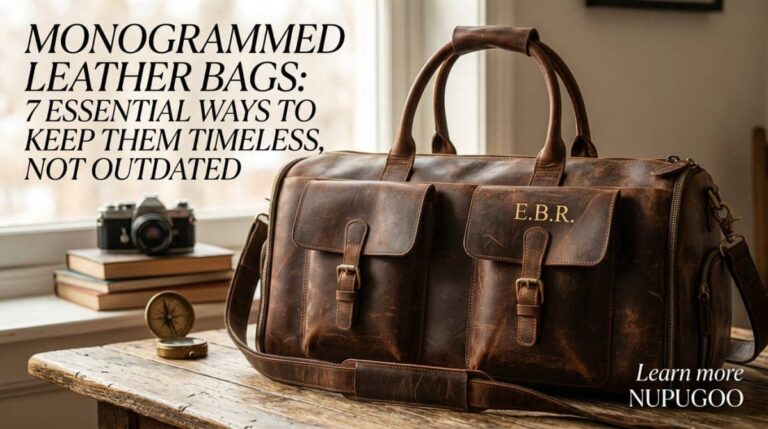
This is what most people mean when they ask for an “embossed” monogram or logo on a leather bag. The tactile quality — the impression you feel under your fingertips — is a debossed impression. The design is visually prominent because the recessed area creates shadow that makes the letters or shapes visible, even in the same leather color.
Debossing is more practical for bags that receive daily use. The recessed design is protected from surface abrasion because it is below the surface plane — whatever is pressing against the bag is pressing against the flat leather around the design, not against the design itself. This is why debossing holds so reliably on leather bags used for years.
The Practical Difference
| Embossed | Debossed | |
|---|---|---|
| Design position | Raised above surface | Recessed below surface |
| Durability on bags | Lower — raised areas wear first | Higher — design protected by surrounding surface |
| Typical use | Decorative motifs, borders | Monograms, logos, text |
| Feel under finger | Design rises toward you | Design pulls away from you |
| Shadow/visibility | Shadow is under the raised design | Shadow is inside the recessed design |
| Common on leather bags | Less common | Very common |
How the Industry Uses These Words
Here is the practical reality: most leather bag brands, retailers, and even some manufacturers use “embossed” to mean what is technically “debossed.” When a leather wallet is described as having an “embossed monogram,” it almost certainly has a debossed monogram — recessed into the leather, not raised above it.
This is not technically correct, but it is the prevailing usage. When you are reading product descriptions, “embossed” usually means “has a tactile impression in the leather.” Whether that impression is raised or recessed is usually clear from the product photos.
When you are placing a custom order and precision matters, specify whether you want a raised or recessed impression. If you want the design to sit below the surface — which is the standard for most professional custom leather work — say “debossed” or “recessed impression.”
Heat Stamping and Its Relationship to Both
Heat stamping is a separate technique but related: it combines a metal die with heat and pressure to permanently set an impression in the leather. Heat stamping can be done in a debossed configuration (most common) or an embossed configuration.
The heat element matters because it helps the leather fibers permanently retain the shape of the impression. Without heat, leather will slowly try to recover its original position — particularly in softer, more pliable leathers. With heat stamping on vegetable-tanned or crazy horse leather, the impression is set immediately and holds with exceptional permanence.
Most professional monogramming on leather goods uses heat stamping in a debossed configuration. This combination produces the cleanest, most durable custom impressions on natural leather.
Which to Choose
For most custom leather bag applications:
A debossed impression is what you want. It holds better, it is more standard, and it reads clearly on the leather surface through shadow and depth contrast. This is what a professional monogrammer will deliver by default.
A raised embossed impression makes sense for decorative elements where the three-dimensional quality is a design choice — a raised crest on a portfolio cover, a raised border on a wallet edge — and where the placement protects the raised area from constant friction.
If you are ordering custom work and the listing says “embossed,” look at the product photos carefully. The photos will tell you whether the design is raised or recessed, regardless of what word the listing uses.